
Introduction to Oscillations and Waves
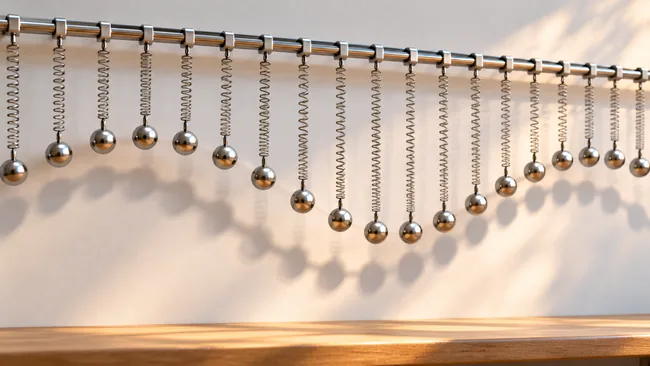
Course facts
- Payment: Free, no certificate
- Credits: Non Credit
- Learning style: Self-paced, start anytime
- Resources: Exam Solutions; Exams; Instructor Insights; Lecture Notes; Problem Set Solutions; Problem Sets
MIT OpenCourseWare details
- As taught in: Summer 2017
- Department: Physics

| Course Details | ||||||
|---|---|---|---|---|---|---|
|
||||||
| Outcomes | ||||||
|
||||||
| Price & Terms | ||||||
|
||||||
| Technical | ||||||
|
||||||
| Specification | ||||||
|
||||||

Oscillations and waves: harmonic, damped and driven oscillators, normal modes, standing and traveling waves, electromagnetic waves and phase space.
Why do oscillations appear in so many systems near equilibrium, and how are they related to waves? This course covers the basic mathematics and physics of both, written for a six-week summer program for high school students: the simple harmonic oscillator and pendulum, damped and driven oscillations and resonance, coupled oscillations and normal modes, the wave equation and standing waves, traveling waves at boundaries, Maxwell’s equations and electromagnetic waves, and linear dynamics with phase space and limit cycles.
What You Will Achieve
- Model the simple harmonic oscillator and the pendulum with equations of motion
- Analyze damped, driven and resonant oscillations
- Find the normal modes of coupled oscillators using eigenvalues and eigenvectors
- Describe standing, traveling and electromagnetic waves mathematically
Program Overview
Single Oscillators
One oscillator at a time: free, damped and driven.
- Mathematical modeling and physics
- Simple harmonic oscillator, classical pendulum and general oscillations
- Damped oscillations
- Driven oscillations and resonance
Coupled Oscillations and Waves
How connected oscillators give rise to waves.
- Coupled oscillations and normal modes
- Wave equation and standing waves
- Traveling waves and boundary interactions
- Maxwell’s equations and electromagnetic waves
Stability and Phase Space
Stability and the geometry of motion.
- One-dimensional linear systems and fixed points
- Phase space of two-dimensional systems
- Limit cycles and self-oscillation
Course Completion
Job Outlook
Oscillations and waves underpin study in physics and engineering, including acoustics, optics, electronics, structural vibration and signal processing.
Good for: Ambitious high school or early college students who want a clear, rigorous first look at oscillations and waves.
Keep in mind: There are no videos and no textbook: the course is lecture notes with problem sets and exams, all with solutions.
Bottom line: A well-organized introduction to oscillations and waves, with full solutions to check every problem set and exam.
Frequently Asked Questions
Which books can I read alongside the notes?
There is no textbook. The notes point to The Physics of Vibrations and Waves by Pain, The Physics of Waves by Georgi and David Morin's waves notes, and say which chapters overlap.
Do the problem sets ask for more than calculations?
Yes. Solutions are expected in both words and equations, and some problems invite you to ask and answer your own questions about physical systems or write short programs.
What does the final exam look like?
It has an individual part and a group part, and solutions are published for both, along with the midterm and every problem set, including a starter set.



There are no reviews yet.