
Art of Color
Course facts
- Payment: Free, no certificate
- Credits: Non Credit
- Learning style: Self-paced, start anytime
- Resources: Projects with Examples
MIT OpenCourseWare details
- As taught in: Spring 2005
- Department: Experimental Study Group

| Course Details | ||||||
|---|---|---|---|---|---|---|
|
||||||
| Outcomes | ||||||
|
||||||
| Price & Terms | ||||||
|
||||||
| Technical | ||||||
|
||||||
| Specification | ||||||
|
||||||

Hands-on color projects: value, balance, warm and cold colors, color as expression and impression, and watercolor painting, with examples.
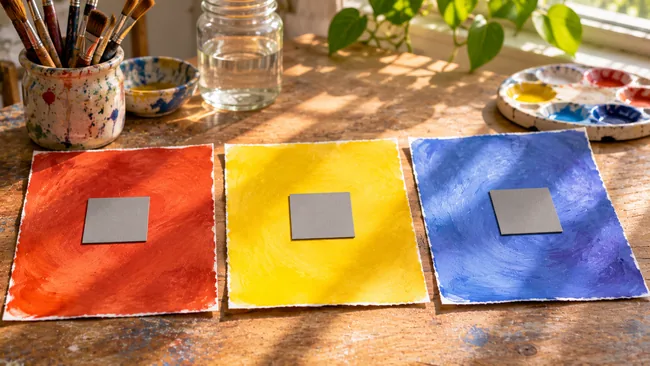
What happens when the same color square sits on three different grounds? This studio seminar explores questions like that through hands-on projects, starting from the principles of visual design and moving into color and value balance, warm and cold colors, and color as expression and impression. It also considers the historical use of color in the arts and its science, then turns to watercolor painting and a large final project.
What You Will Achieve
- Organize colors by value and build a color wheel
- Create balanced compositions using grays and colors
- Render emotional states and physical concepts in color alone
- Compose and mount a series of watercolor paintings
Program Overview
Interaction of Color
First exercises on how colors affect each other.
- Fully saturated color squares
- Color values
- Color wheel
- Letters and color transparency
Color as Expression
Balance, tension and feeling in color.
- Color balance
- Color as impression
- Searching for tension
- Warm-cold colors
Learning To Use Watercolors
Paint replaces cut paper in the later sessions.
- Composition and painting
- Painting studio
- Final review
Course Completion
Job Outlook
These studio skills support work and further study in visual art and design, wherever color choices matter.
Good for: Beginners in art and curious people from other fields who want a structured set of color exercises to do by hand.
Keep in mind: You will need to buy supplies, including Color-Aid paper, gouache and a textbook by Itten. Published materials are project descriptions with examples, so the critique a studio offers is missing.
Bottom line: An inviting, well-specified sequence of color projects that you can realistically work through at home.
Frequently Asked Questions
What supplies are needed?
The list includes Color-Aid paper with 220 colors, gray values, a Pelikan gouache set, white coverstock, a metal ruler, a utility knife, and rubber cement.
What is an example project?
In one, you pick three physical and three abstract concepts, such as twilight or anxiety, and express each using pure color and minimal form.
Which book does the course use?
The Art of Color by Johannes Itten, in the revised edition translated by Ernst van Haagen, is the listed textbook.
User Reviews
Write your review
You must be logged in to post a review.
Reviews can only be posted by registered learners. Log in or create a free account, then you will return here to post.



There are no reviews yet.