
Deep Learning for Images with PyTorch
| Course Details | ||||||||
|---|---|---|---|---|---|---|---|---|
|
||||||||
| Languages | ||||||||
|
||||||||
| Outcomes | ||||||||
|
||||||||
| Price & Terms | ||||||||
|
||||||||
| Technical | ||||||||
|
||||||||
| Specification | ||||||||
|
||||||||
Build PyTorch models that classify images, detect objects with bounding boxes, segment them with masks and generate new images with GANs.
Deep learning for images goes beyond naming what a picture shows: models can also locate each object, trace its outline with a mask, and produce new images altogether. Working in PyTorch, you build convolutional networks for each of these jobs, reuse pre-trained models to cut training time, and check results with task-specific measures such as IoU for predicted boxes and the Fréchet Inception Distance for generated pictures.
What You Will Achieve
- Adapt a pre-trained ResNet to classify images into two or more classes in PyTorch
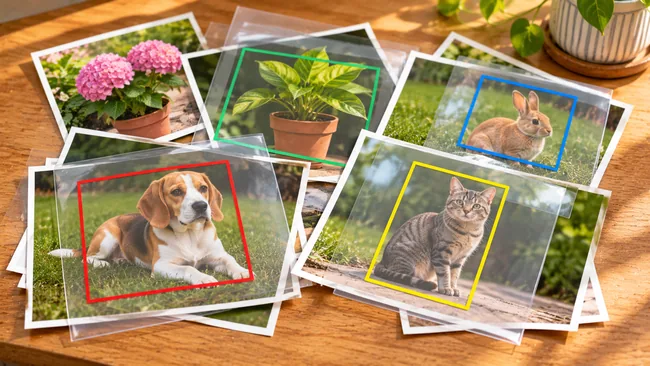
- Draw and predict bounding boxes, score them with IoU and apply NMS to the predictions
- Create binary masks and run Mask R-CNN and U-Net models to segment the objects in an image
- Build and train a DCGAN with its generator and discriminator losses, then judge the quality and variety of its images
Program Overview
Image Classification and Transfer Learning
Convolutional networks for binary and multi-class tasks, and the reuse of models that have already been trained.
- Binary and multi-class classification models
- Convolutional layers, color channels and sequential blocks
- Saving, loading and reusing pre-trained models
- Classification with ResNet
Object Detection and Image Segmentation
Locating objects with bounding boxes and region-based networks, then separating image regions with semantic, instance and panoptic masks.
- Bounding boxes, IoU and NMS
- R-CNN and Faster R-CNN with anchor generators and RPN losses
- Binary and soft masks with Mask R-CNN
- Semantic segmentation with U-Net and panoptic mask overlays
Generating Images with Deep Convolutional GANs
Building a generator and a discriminator, training them with their own losses, and assessing the images the model produces.
- GAN intuition: generator and discriminator
- Convolutional generator and discriminator
- Loss functions and the training loop
- Fréchet Inception Distance
Certificate Awarded (Paid)
Job Outlook
These skills are used in deep learning work on images: classifying them, detecting and segmenting the objects they show, and generating new ones with PyTorch models.
Good for: Learners who want working PyTorch code for several computer vision tasks, with pre-trained detection and segmentation models they can adapt to their own images.
Keep in mind: This is an advanced course that assumes you already build and train neural networks in PyTorch, so the lessons move straight into image-specific models.
Bottom line: A hands-on PyTorch course that pairs each image task with a working model, checking detections with IoU and generated images with Fréchet Inception Distance.
Frequently Asked Questions
Which pre-trained models does the course use?
The classification chapter loads a pre-trained ResNet, the detection chapter builds R-CNN on a pre-trained backbone, and the segmentation chapter runs a pre-trained Mask R-CNN. Reusing these models is how the course approaches transfer learning.
How are the three segmentation types handled?
Each type gets its own architecture: U-Net for semantic segmentation, Mask R-CNN for instance segmentation, and a panoptic step that sets up semantic masks and overlays the instance masks on them.
How are the generated images evaluated?
The final chapter looks at both the quality and the variety of what the DCGAN produces. After generating a set of images, you calculate the Fréchet Inception Distance to score the results.
Do the exercises involve writing model code?
Yes. Many exercises have you write PyTorch code directly, such as adding a convolutional layer, defining the layers and forward method of a U-Net, and writing the training loop for a GAN.




There are no reviews yet.