
General Relativity
Course facts
- Payment: Free, no certificate
- Credits: Non Credit
- Learning style: Self-paced, start anytime
- Resources: Lecture Videos; Problem Sets
MIT OpenCourseWare details
- As taught in: Spring 2020
- Department: Physics

| Course Details | ||||||
|---|---|---|---|---|---|---|
|
||||||
| Outcomes | ||||||
|
||||||
| Price & Terms | ||||||
|
||||||
| Technical | ||||||
|
||||||
| Specification | ||||||
|
||||||

Graduate video lectures on general relativity: tensors, curvature, the Einstein equation, gravitational radiation, cosmology and black holes, with problem sets.
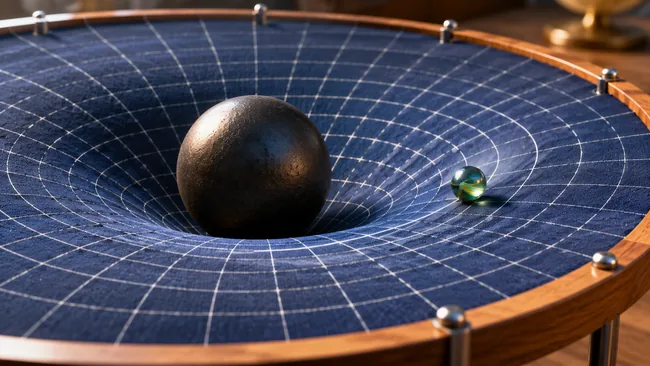
Einstein’s theory is taught here at full graduate strength, with a first half on foundations and a second on applications. Video lectures by Prof. Hughes begin with tensors and the geometric view of physics, reach the field equation, then cover gravitational radiation, cosmology and black holes. Sean Carroll’s Spacetime and Geometry is the textbook.
What You Will Achieve
- Work with tensors, parallel transport and geodesics
- Explain spacetime curvature and the principle of equivalence
- Derive the Einstein field equation
- Analyze gravitational radiation, cosmology and black holes
Program Overview
Geometry of Physics
The first lectures build the mathematics.
- Introduction to tensors
- Stress energy tensor and the Christoffel symbol
- Lie transport and Killing vectors
- Geodesics
Curvature and the Field Equation
Next the theory itself takes shape.
- The principle of equivalence
- Spacetime curvature
- The Einstein field equation
Applications
The second half turns to the most important uses.
- Linearized gravity
- Gravitational radiation
- Cosmology
- Spherical compact sources and black holes
Course Completion
Job Outlook
This is core preparation for research in gravitational physics, astrophysics and cosmology.
Good for: Physics graduate students and advanced undergraduates comfortable with electromagnetism, Lagrangians and differential equations.
Keep in mind: The videos are from spring 2020, but the problem sets are the 2006 version, with hints for only some and no solutions. The two advanced topics lectures at the end were not captured on video.
Bottom line: A full graduate lecture series on a hard subject, excellent if you can check your own problem work.
Frequently Asked Questions
Do the problem sets match the videos?
Not exactly. The 2020 problem sets are unavailable, so the page gives the 2006 version, with hints for some of the eleven sets.
Are all the lectures on video?
All but the last two. Lectures 24 and 25 on advanced topics are marked as not video captured.
Does any homework need programming?
Some of it does. The syllabus says some assignments require the numerical solution of systems of differential equations, so numerical analysis helps.


There are no reviews yet.