
Industrial Biotechnology
Course facts
- Payment: Free to learn, certificate paid
- Credits: Non Credit
- Learning style: Self-paced, start anytime
- Format: Video Based
- Before you start: High school understanding of Mathematics First year undergraduate level of (bio)Chemistry and Biology
edX details
- Pacing: Self-paced
- Available until: Jun 23, 2027

| Course Details | ||||||||
|---|---|---|---|---|---|---|---|---|
|
||||||||
| Languages | ||||||||
|
||||||||
| Outcomes | ||||||||
|
||||||||
| Price & Terms | ||||||||
|
||||||||
| Technical | ||||||||
|
||||||||
| Specification | ||||||||
|
||||||||

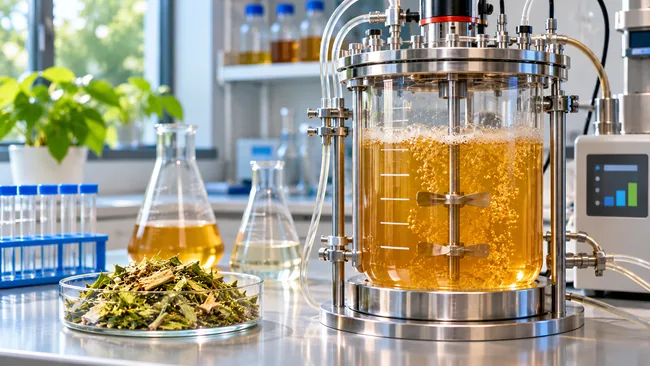
Learn to design fermentation-based processes that turn renewable feedstocks into biobased products, and assess their costs and sustainability.
Microorganisms can turn organic residues and CO2 into biomaterials, chemicals, nutrition products and biofuels, giving industry a renewable alternative to the fossil-based fuels and raw materials that drive climate change. The lessons show how the choice of product and feedstock sets the requirements of a fermentation-based process. Along the way you design a biotechnological process of your own and judge how well it performs and how sustainable it is.
What You Will Achieve
- Explain how sustainable innovation and biobased production can replace fossil-based raw materials
- Trace a bioproduct through the biobased economy, linking raw materials, research and application
- Work through basic bioprocess engineering calculations for a fermentation
- Draft your own biotechnological process and weigh its performance, costs and environmental effects
Program Overview
Biobased Products and Fermentation Essentials
Sets out why a circular economy needs industrial biotechnology, then explains how microbes behave in a fermentation, using bio-PDO (1,3-propanediol) as the running case.
- Biobased and circular economy and its benefits for society
- Renewable biomass and CCU feedstocks
- Microbes, rates, balances and the black box model
- Fermentation technology and scale-up via scale-down
Downstream Processing and Integrated Bioprocess Design
Covers how products are recovered after fermentation and how feedstock choices shape an integrated, zero-emission bioprocess.
- Separation in stages: mechanical and molecular methods
- Feedstock generations and pre-treatment
- Alternative carbon, electron and energy sources
- Syngas fermentation to ethanol
Process Design and Sustainability Assessment
Brings the parts together into a conceptual design and evaluates it on economic, environmental and social grounds, closing with an outlook lecture.
- Conceptual process design with mass and energy balances
- Process economics
- Environmental impact analysis and life cycle assessment
- Social sustainability in a global context
Certificate Awarded (Paid)
Pass the final assessment to earn it. The course is free to study; the certificate is optional and has a fee.
Job Outlook
These skills apply in bioprocess development, in fermentation-based production of chemicals, materials, nutrition products and biofuels, and in assessing the costs and sustainability of industrial processes.
Good for: Science and engineering learners who want to see how a fermentation-based process for a biobased product is designed, scaled and evaluated.
Keep in mind: The calculations stay at a basic bioprocess engineering level, and the worked cases center on bio-PDO (1,3-propanediol) and syngas fermentation to ethanol.
Bottom line: A process-design course built around the fermentation and separation of bio-PDO, ending with an economic, environmental and social assessment of a process you design.
Frequently Asked Questions
Which product serves as the running case study?
The course follows bio-PDO, or 1,3-propanediol, across several weeks: its production process appears early, it anchors the fermentation essentials, and dedicated PDO cases close the downstream processing material. Syngas fermentation to ethanol is the other worked example, in the part on integral bioprocess design.
Do I design a bioprocess of my own?
Yes. Throughout the weeks you are challenged to design a biotechnological process of your own and then evaluate its performance and sustainability, drawing on the fermentation, separation, process economics and life cycle assessment material.
Which feedstocks does the course look at?
Renewable biomass and CCU sources come first. Later lessons cover first and second generation feedstocks with the pre-treatment needed for high quality input, then third to fifth generation feedstocks that supply alternative carbon, electron and energy sources.
Are there guest lectures in the course?
Yes. Alongside eight course leaders, the course includes guest lectures from industry and universities, and a closing lecture looks at the outlook for industrial biotechnology.
Please log in to report a problem with this page.



There are no reviews yet.