
Building Robots: Electrical Drives
Course facts
- Payment: Free to learn, certificate paid
- Credits: Non Credit
- Learning style: Self-paced, start anytime
- Format: Video Based
- Before you start: Knowledge of linear circuits Basic electronics and control Experience in microcontroller programming
edX details
- Pacing: Self-paced
- Available until: Dec 10, 2026

| Course Details | ||||||||
|---|---|---|---|---|---|---|---|---|
|
||||||||
| Languages | ||||||||
|
||||||||
| Outcomes | ||||||||
|
||||||||
| Price & Terms | ||||||||
|
||||||||
| Technical | ||||||||
|
||||||||
| Specification | ||||||||
|
||||||||

Model, simulate and tune a DC electrical drive for robots, covering motors, power converters and PI control, then implement it in a closed-loop project.

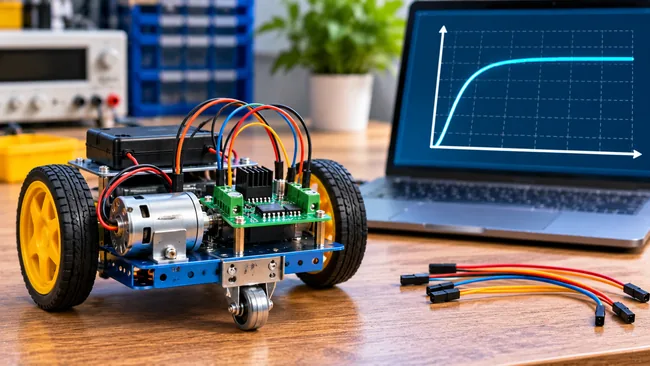
Electrical drives give a robot its controlled motion by linking a motor, the power electronics that feed it, the sensors that measure it and the loop that controls it. You model and simulate a DC-motor-based drive, calculate the voltage a power converter delivers from its duty cycles, design and tune a PI controller, and then put the hardware and control loop together so the drive tracks speed and position.
What You Will Achieve
- Make critical design choices for a DC drive within given specifications
- Model and simulate a DC-motor-based drive as a component for robot system integration
- Set controller gains for a DC drive from its transfer function, then refine them through stepwise testing
- Deploy motor drive hardware and implement the closed-loop control of a DC drive
Program Overview
Motors, Actuators and DC Machine Principles
Why robots rely on motors and drives, how different actuators operate, and how a DC machine is built, described mathematically and simulated.
- Role of motors and drives in robotics
- Operating principles of motors and actuators
- DC machine structure and equivalent circuit
- Performance calculation and dynamic model of a DC machine
Power Converters and DC Drive Architecture
The power electronics and hardware that sit between the controller and the motor, and how they are arranged for feedback control.
- Semiconductor types and the half-bridge building block
- Pulse-width modulation and output voltage from duty cycles
- DC drive hardware and feedback sensors
- Control block diagram and open-loop drive simulation
Closed-Loop Control and Implementation
Designing the speed and position controller on paper and in simulation, then building and tuning it on the course hardware.
- DC drive dynamics and PI controllers
- Discrete PI controller implementation
- Empirical, stepwise tuning of the control loop
- Project: speed and position tracking with given hardware
Certificate Awarded (Paid)
Complete the course to earn it. The course is free to study; the certificate is optional and has a fee.
Job Outlook
Electrical drive skills are used wherever machines need controlled motion, including robots in manufacturing, agriculture and household settings, and in student thesis projects built on adaptable, open-source mechatronic hardware.
Good for: Engineering students and young engineers who want to see how a robot’s motor, power electronics and control loop fit together, and engineers refreshing their drive fundamentals.
Keep in mind: It is one course of the GEMS online program on building robots; this part centers on electrical drives and motion control, with sensing and communication treated through their role in the drive.
Bottom line: A simulation-backed walk through DC drive design that ends in a speed and position tracking project on modular, open-source mechatronic hardware.
Frequently Asked Questions
What language is the drive control programmed in?
The course uses the ANSI C language. Basic flow-control instructions and concepts such as functions and variables are enough to follow its programming.
What hardware does the final project use?
The project uses modular mechatronic educational hardware whose hardware designs and firmware are open source. Learners realize closed-loop speed tracking and position tracking with the given hardware and control algorithms, tuning the loop step by step.
How are simulation models used along the way?
Simulation appears in most weeks: learners simulate a DC machine model, a power converter, an open-loop DC drive and then a closed-loop drive with a tuned controller, before implementing the drive on hardware.
Is the course part of a larger program?
Yes. It belongs to an online program on building robots developed by partners in the Erasmus+ project GEMS (Graceful Equalizing of Mechatronics Students), in which Delft University of Technology leads the robotics part through motion control.
Please log in to report a problem with this page.



There are no reviews yet.