
Galapagos and Biomorpher on Grasshopper: Al Bahr example
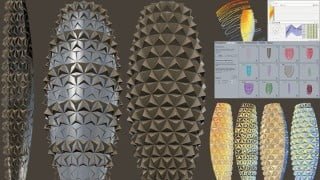

Learn how to create a responsive façade using genetic algorithms and artificial intelligence techniques in this course for architects and designers. Maximize the use of sunlight and solar radiation in building façades through AI.
What you’ll learn
- Application of genetic algorithms to take advantage of incident radiation and sunlight
- Application of evolutionary algorithms to take advantage of incident radiation and sunlight
- Creation of parametric tower and application of materials for rendering in rapid building prototyping
- Creation of responsive façades and application of materials for rendering in rapid building prototyping
In this guided project, we will create an Al Bahr type facade where we will make the most of this type of responsive facade through one of the branches of artificial intelligence: Genetic algorithms.
According to wikipedia: a genetic algorithm (GA) is a metaheuristic inspired by the process of natural selection that belongs to the larger class of evolutionary algorithms (EA). Genetic algorithms are commonly used to generate high-quality solutions to optimization and search problems by relying on biologically inspired operators such as mutation, crossover and selection. Genetic algorithms in particular became popular through the work of John Holland in the early 1970s, and particularly his book Adaptation in Natural and Artificial Systems (1975). His work originated with studies of cellular automata, conducted by Holland and his students at the University of Michigan. Holland introduced a formalized framework for predicting the quality of the next generation, known as Holland’s Schema Theorem. Research in GAs remained largely theoretical until the mid-1980s, when The First International Conference on Genetic Algorithms was held in Pittsburgh, Pennsylvania.
These will be the topics that we will see during this project:
Create a tower from a polygon and assign glass material for rapid prototyping rendering.
Create a responsive façade and assign materials to these façades.
We will generate an attractor and several point attractors in response to this responsive facade.
Explanation of the genetic and evolutionary algorithms using Galapagos and Biomorpher
We will incorporate the sunshine of a specific place using Ladybug
We will incorporate the annual solar incidence and by specific dates using Ladybug
We will see in greater detail the application of genetic and evolutionary algorithms, taking into account the annual solar incidence to see the response of this facade and review the characteristics that can be modified and maximized using artificial intelligence.
Who this course is for:
- Architects or designers focused on parametric design
- Architects interested in the use of artificial intelligence (AI) techniques applied to façades
- Architects interested in the use of sunlight and solar radiation in façades through AI
User Reviews
Be the first to review “Galapagos and Biomorpher on Grasshopper: Al Bahr example”
You must be logged in to post a review.





There are no reviews yet.