
Aerospace Biomedical and Life Support Engineering
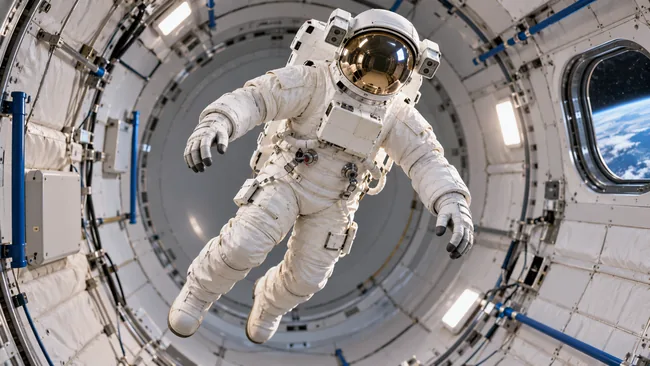
Course facts
- Payment: Free, no certificate
- Credits: Non Credit
- Learning style: Self-paced, start anytime
- Resources: Exam Solutions; Exams; Problem Set Solutions; Problem Sets; Written Assignments
MIT OpenCourseWare details
- As taught in: Spring 2006
- Department: Aeronautics and Astronautics, Health Sciences and Technology, Institute for Data, Systems, and Society

| Course Details | ||||||
|---|---|---|---|---|---|---|
|
||||||
| Outcomes | ||||||
|
||||||
| Price & Terms | ||||||
|
||||||
| Technical | ||||||
|
||||||
| Specification | ||||||
|
||||||

An engineering course on how the body adapts to microgravity, covering bone, muscle, the heart, countermeasures and spacewalks through problem sets.
Reduced gravity changes bones, muscles and the cardiovascular system, and engineers have to work out how much and what might counter it. This course treats astronaut adaptation as a quantitative problem. Each body system begins with biology and ends with engineering analysis, and the term closes with students teaching a chosen concept to others.
What You Will Achieve
- Model astronaut performance with control theory, circuits and mechanical analogs
- Analyze how bone and muscle change in reduced gravity
- Assess the effectiveness of countermeasures quantitatively
- Consider the policy questions raised by human space flight research
Program Overview
Humans in Space and Bone Changes
Opening sessions set out the physiological problems of space flight and extreme environments, then bone.
- Humans in space
- Exploration in extreme environments
- Bone changes in space
Muscle and Motor Control
The class builds up muscle mechanisms and then uses them in models of movement.
- Muscle mechanisms
- Motor control optimization
- Musculoskeletal dynamics and control
Cardiovascular System and EVA
Later work simulates the heart and circulation, then considers artificial gravity, spacewalks and outreach projects.
- Cardiovascular control and simulation
- Countermeasures and artificial gravity
- Extravehicular activity
- Teaching and outreach
Course Completion
Job Outlook
These methods apply to human spaceflight engineering, biomedical research, life support design and the study of the body in extreme environments.
Good for: Aerospace and biomedical engineering students curious about astronaut health, and engineers who want to apply modeling skills to the human body.
Keep in mind: You get problem sets, a quiz and their solutions, but no lecture notes or recordings, so you have to find background on physiology elsewhere. The materials date from 2006.
Bottom line: A distinctive assignment-based course on the engineering of humans in space, with solid problems and little explanation around them.
Frequently Asked Questions
What is in the assignment set?
There are five assignments with solutions, some with script and model files to run, plus a term project with guidelines and self-assessments. One quiz is published with its solution.
What must the term project show?
Students show mastery of a chosen engineering concept by teaching it to others and doing outreach. The published guidelines and self-assessment forms describe what the project expects of them.
Does it cover spacewalks?
Yes. Two sessions deal with extravehicular activity, one on the topic itself and one on related research, and they follow sessions on countermeasures and artificial gravity.

There are no reviews yet.