
Introduction to Electrical Engineering and Computer Science I
Course facts
- Payment: Free, no certificate
- Credits: Non Credit
- Learning style: Self-paced, start anytime
- Resources: Exam Solutions; Exams; Instructor Insights; Lecture Notes; Lecture Videos; Open Textbooks; Problem Sets; Problem-solving Videos; Programming Assignments
MIT OpenCourseWare details
- As taught in: Spring 2011
- Department: Electrical Engineering and Computer Science

| Course Details | ||||||
|---|---|---|---|---|---|---|
|
||||||
| Outcomes | ||||||
|
||||||
| Price & Terms | ||||||
|
||||||
| Technical | ||||||
|
||||||
| Specification | ||||||
|
||||||

An integrated start in EE and CS through Python, control systems, circuits and probability, with lecture videos, labs and exams for self-study.
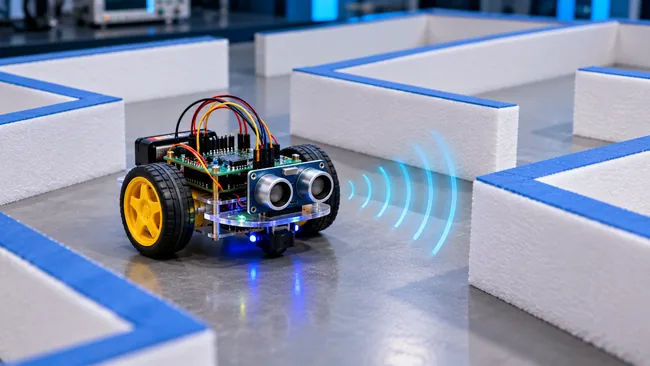
Mobile robots give this course a reason to bring programming, control, circuits and probability together. Its main goal is to teach the design principles of modularity and abstraction across those subjects, and to show that a mathematical model of a real system helps in designing it. The site is built for independent study, with lectures, recitations, notes, labs and exams.
What You Will Achieve
- Write object-oriented Python programs and state machines
- Characterize and design control systems using signals and systems analysis
- Analyze circuits with op-amps and circuit abstractions
- Apply discrete probability, state estimation and search algorithms to decision-making
Program Overview
Software Engineering
A Python tutorial leads into programming structures used for the rest of the course.
- Python Tutorial
- Object-oriented programming
- State machines
Signals, Systems and Circuits
The middle units model system behavior and the electronics that implement it.
- LTI signals and systems
- Designing control systems
- Op-amps
- Circuit abstractions
Probability and Planning
The last unit turns to decisions under uncertainty, and it carries the most weight on the final exam.
- Discrete probability
- State estimation
- Search algorithms
- Optimizing a search
Course Completion
Job Outlook
This foundation leads into further electrical engineering and computer science study, including digital communication systems, circuits and electronics.
Good for: Self-directed learners who want a broad, connected start in electrical engineering and computer science, with enough exercises to measure their progress.
Keep in mind: MIT’s online tutor is not included, so those problems come as PDFs with no solutions, and the design labs assume mobile robots. Lectures date from spring 2011, most activities from fall 2011.
Bottom line: A self-study package with lecture videos, an open textbook, and exams and solutions from five semesters.
Frequently Asked Questions
Can you do the labs without the robots?
The software and design labs are published, but MIT students built and worked with mobile robots in the design labs. The site does not say a robot is supplied, so plan for that limit.
Are exam solutions included?
Yes. Exams and solutions are published for five semesters, spring 2009 through spring 2011. The final is comprehensive, with topics from Unit 4 weighted more heavily.
How much time did MIT students spend each week?
They were expected to spend 12.5 hours a week on lectures, a software lab, a design lab, online tutor exercises, readings and exam preparation.



There are no reviews yet.