
Electrical Engineering
Electrical Engineering courses illuminate the principles of electromagnetism and circuit theory, teaching professionals how to design the power systems, electronics, and communication networks that electrify the modern world.
Read More
- Key Skills:
- Circuit analysis, power systems analysis, signal processing, control systems, electromagnetics, MATLAB/Simulink, PCB design.
- Typical Duration:
- Most courses take 10–40 hours.
- Top Providers:
- SWAYAM, MIT OpenCourseWare, NPTEL+
Powering the Future
Electrical Engineering is the invisible force behind modern life. It is the discipline that turns the abstract physics of electrons into useful work. Education in this field begins with the fundamental laws of circuits—Ohm’s Law and Kirchhoff’s Laws—before branching into two main rivers: Power and Electronics. Power engineers focus on the grid, learning how to generate gigawatts of electricity at a dam or solar farm and transmit it efficiently across continents. You will study “Three-Phase Power,” transformers, and the complex grid stability challenges posed by renewable energy integration.
On the flip side, the curriculum dives into the manipulation of information via signals. You will master “Signal Processing,” using math to clean up audio, compress video for streaming, or filter noise from radar data. Control Systems is another critical pillar, teaching you how to use feedback loops to keep a drone stable in the wind or maintain the precise temperature of a chemical reactor. Whether you are designing the next generation of 5G antennas or the battery management system for an electric vehicle, the core skill remains the same: mathematically modeling the flow of energy to predict and control its behavior.
Who Should Enroll?
- Electricians: Tradespeople looking to deepen their theoretical understanding to move into design or engineering management roles.
- Mechanical Engineers: Professionals seeking to cross-train in mechatronics to better integrate motors and sensors into their designs.
- Tech Enthusiasts: Makers and hobbyists who want to graduate from simple Arduino projects to designing professional-grade printed circuit boards (PCBs).
- Energy Sector Workers: Individuals involved in solar or wind installation who need to understand the grid interconnection standards and power electronics.
Enroll in an Electrical Engineering course today to master the currents that drive innovation and power the infrastructure of tomorrow.
Showing all 9 resultsSorted by latest







Frequently Asked Questions about Electrical Engineering Courses
1. What is the difference between Electrical and Electronics Engineering?
Electrical Engineering typically focuses on large-scale production and distribution of electrical power (high voltage, generators, motors). Electronics Engineering focuses on small-scale electronic circuits and devices (microchips, transistors, sensors). However, the two fields overlap significantly, and many university degrees cover both under a single umbrella.
2. Do I need to be good at math?
Yes, Electrical Engineering is extremely math-heavy. You will use calculus, differential equations, and complex numbers (imaginary numbers) extensively to model AC circuits and electromagnetic waves. While simulation software handles the brute force calculation, you need the math to understand why the circuit behaves the way it does.
3. What software will I learn?
MATLAB and Simulink are the industry standards for modeling and signal processing. For circuit design and simulation, you will likely use SPICE (like LTspice or PSpice). For Printed Circuit Board (PCB) design, tools like Altium Designer, Eagle, or KiCad are commonly taught.
4. What is “Signal Processing”?
Signal Processing is the science of analyzing, modifying, and synthesizing signals like sound, images, and biological measurements. You learn to use algorithms (like the Fast Fourier Transform) to filter out noise, compress data (like MP3s), or enhance image quality. It is the technology behind everything from noise-canceling headphones to MRI machines.
5. How does this field relate to Renewable Energy?
Electrical engineers are the architects of the renewable energy transition. Courses cover “Power Electronics”—the inverters that convert DC power from solar panels into AC power for the grid. You also study “Smart Grids,” learning how to balance variable energy sources like wind with demand response technologies.
6. What are “Control Systems”?
Control Systems engineering deals with maintaining a desired output despite external disturbances. A classic example is cruise control in a car. You learn to design mathematical feedback loops (PID controllers) that constantly adjust inputs to keep systems stable, whether it’s a robotic arm or a chemical plant.
7. What is “Embedded Systems” design?
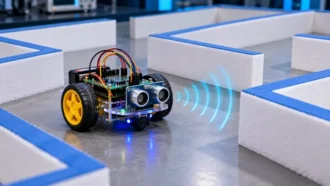
Embedded Systems involve integrating a small computer (microcontroller) into a mechanical or electrical system to control it. You learn to program chips like Arduino or STM32 using C/C++ to read sensors and drive motors. This skill sits at the intersection of electrical engineering and computer science.
8. Can I get a PE license with an online degree?
It depends on the accreditation. To get a Professional Engineer (PE) license in the US, your degree typically needs to be ABET-accredited. Some online master’s programs are accredited, but many short certificate courses are not. Always check the accreditation status if licensure is your goal.
9. Is soldering required?
Soldering is a practical skill that is useful for prototyping and repair, but it is not the primary focus of engineering. Engineering is about designing the circuit so it works. However, knowing how to solder helps you build and test your own prototypes, which is a valuable hands-on skill.
10. What are the career prospects?
Career prospects are excellent and diverse. You can work in power generation, telecommunications, automotive (EVs), aerospace, or consumer electronics. The shift towards electrification in transport and heating is creating a massive demand for engineers who understand power systems and battery technology.