
Recreate Experiments from History: Inform the Future from the Past: Galileo
Course facts
- Payment: Free, no certificate
- Credits: Non Credit
- Learning style: Self-paced, start anytime
- Resources: Activity Assignments; Image Gallery; Lecture Notes; Projects; Written Assignments with Examples
MIT OpenCourseWare details
- As taught in: January IAP 2010
- Department: Edgerton Center

| Course Details | ||||||
|---|---|---|---|---|---|---|
|
||||||
| Outcomes | ||||||
|
||||||
| Price & Terms | ||||||
|
||||||
| Technical | ||||||
|
||||||
| Specification | ||||||
|
||||||

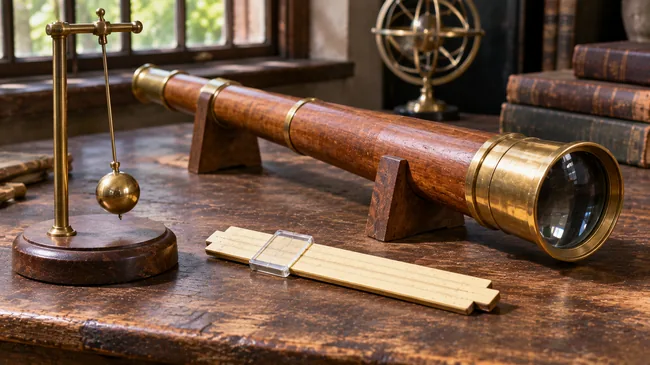
Recreate Galileo’s seeing and experimenting with lenses, mirrors and his compass, guided by readings, historical collections and your own curiosity.
What was it like to improvise new ways of seeing? In this exploratory seminar, marking 400 years since Galileo’s observations of the moon and Jupiter, students recreated his work with lenses, frames, mirrors and his calculating compass. Readings, instrument collections and rare books fed their experiments, and their own curiosity set much of the direction.
What You Will Achieve
- Build simple viewing devices using lenses and mirrors
- Observe the moon and sky and record it carefully
- Experiment with motion, sound and materials
- Reflect on Galileo’s story and on how you learn
Program Overview
Looking and Lenses
The early sessions begin with frames and tubes.
- Frame and tube activities
- Shaped mirrors and lenses
- Galileo’s computing device
- Glass-blowing lab visit
Galileo’s Sources
The class also goes to historical collections.
- Sidereus Nuncius
- Harvard instrument collection and Houghton Library
- Responses to Galileo
- Slide rule introduction
Motion and Telescopes
Later sessions move outdoors and into motion experiments.
- Motion, sound and materials
- Galileoscopes
- Telescope viewing
- Class sharing about explorations
Course Completion
Job Outlook
The approach is useful for science teachers, museum educators and anyone interested in the history of science.
Good for: Teachers and curious adults who like learning by making and observing, with history as the guide.
Keep in mind: Grounded in campus visits and shared exploration, so it cannot be fully replicated. Work was graded pass/D/fail. You can follow many of the activities with simple lenses and mirrors.
Bottom line: A delightful, unusual class that treats doubt as a tool; a model for anyone who teaches science.
Frequently Asked Questions
What materials do I need?
Mainly simple things: frames, tubes, string, lenses and pieces of mirror. A small telescope such as a Galileoscope helps for observing the sky.
What written work did students do?
An ongoing notebook journal with sketches and data, class notes for one meeting, and a reflection paper on what they learned.
What is critical exploration?
It is the research method behind the course, in which activities develop from what the group observes and tries, so teaching and learning are intertwined.



There are no reviews yet.