
Industrial Design Intelligence: A Cognitive Approach to Engineering
Course facts
- Payment: Free, no certificate
- Credits: Non Credit
- Learning style: Self-paced, start anytime
- Resources: Lecture Notes; Projects with Examples
MIT OpenCourseWare details
- As taught in: Fall 2003
- Department: Media Arts and Sciences

| Course Details | ||||||
|---|---|---|---|---|---|---|
|
||||||
| Outcomes | ||||||
|
||||||
| Price & Terms | ||||||
|
||||||
| Technical | ||||||
|
||||||
| Specification | ||||||
|
||||||

Apply cognitive science to industrial design: evaluate products, build prototypes and study how perception, memory and motor control shape use.
The look, feel and use of an object tell people what it is worth, and cognitive science can test those impressions instead of guessing at them. Sensation, memory and motor control are studied here alongside the design of real products such as the TrackPoint and ThinkPad, with evaluation built into prototyping and a publication style paper as the written result.
What You Will Achieve
- Evaluate a product with mechanical and electronic aspects using objective approaches
- Deconstruct a product to see how its design decisions were made
- Plan a functioning product prototype that combines electronics and computers
- Write up a product evaluation as a publication style paper
Program Overview
Design Stories and Famous Examples
What engineering and evaluation mean through products with documented histories.
- TrackPoint as an ergonomic product
- Thinkpad design challenges
- Design of the 20th century
- Eames, Loewy and Sapper
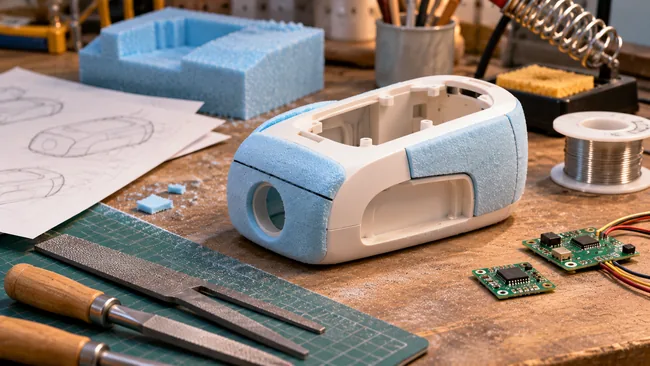
Prototyping and Model Making
Building skills that take an idea to a mock-up that can be tested.
- Physical model making
- Prototyping stories
- Project mock-ups
Cognition and Evaluation
How people perceive and use objects, and how to measure it.
- Sensation and perception
- Memory and learning
- Motor control
- Psychology of everyday things
Course Completion
Job Outlook
The approach fits industrial design and product engineering, where physical products with electronics inside must be prototyped and evaluated with their users in mind.
Good for: Engineers and designers who build physical products with electronics inside and want a cognitive basis for judging them.
Keep in mind: This fall 2003 studio relied on milling, molding, soldering and field trips to design firms, so the page gives lecture notes and student project examples, not the shop practice.
Bottom line: A record of how one seminar joined product stories, cognitive science and shop work, with the students’ projects to study.
Frequently Asked Questions
Which designers and products are discussed?
Sessions look at the TrackPoint and ThinkPad, famous industrial design examples of the 20th century, and the work of Charles Eames, Raymond Loewy and Richard Sapper.
What prototyping skills did the class practice?
The syllabus names milling, cutting, molding, soldering, programming and drawing, along with model making. On the page these appear as lecture notes and a compilation of student work.
What books or readings come up?
The schedule names Design for the Real World, The Idea of Design, ID Magazine and the Psychology of Everyday Things among its discussion topics, and students presented readings in class.
User Reviews
Write your review
You must be logged in to post a review.
Reviews can only be posted by registered learners. Log in or create a free account, then you will return here to post.




There are no reviews yet.