
The Early Universe
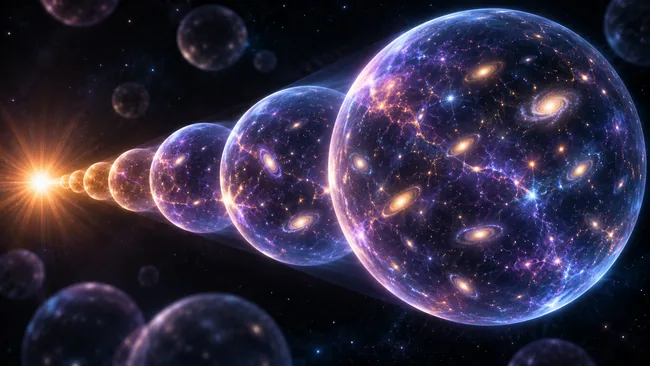
Course facts
- Payment: Free, no certificate
- Credits: Non Credit
- Learning style: Self-paced, start anytime
- Resources: Exam Solutions; Exams; Lecture Videos; Problem Sets
- Before you start: 18.03 Differential Equations, 8.02 Physics II: Electricity and Magnetism
MIT OpenCourseWare details
- As taught in: Fall 2013
- Department: Physics

| Course Details | ||||||
|---|---|---|---|---|---|---|
|
||||||
| Outcomes | ||||||
|
||||||
| Price & Terms | ||||||
|
||||||
| Technical | ||||||
|
||||||
| Specification | ||||||
|
||||||

Modern cosmology in recorded lectures: expansion, redshift, curved space, the CMB, the cosmological constant and inflation.
Is our universe part of a multiverse? This introduction to modern cosmology, in recorded lectures by Alan Guth, starts with classical cosmology and moves on to modern particle physics and its impact on how we understand the universe. It covers the kinematics and dynamics of the expanding universe, cosmological redshift, non-Euclidean spaces and the spacetime metric, black-body radiation and the early history of the universe, the cosmic microwave background, the cosmological constant and vacuum energy, the problems of the conventional hot big bang, and inflation.
What You Will Achieve
- Describe the kinematics and dynamics of a homogeneously expanding universe
- Explain cosmological redshift and the geometry of open and closed universes
- Relate black-body radiation and the cosmic microwave background to the early universe
- Explain how inflation answers problems of the conventional hot big bang model
Program Overview
The Expanding Universe
Redshift, relativity and the dynamics of cosmic expansion.
- The Doppler effect and special relativity
- Kinematics of the homogeneous expanding universe
- Cosmological redshift
- Dynamics of homogeneous expansion
Geometry and the Hot Early Universe
Curved spaces and the thermal history of the cosmos.
- Non-Euclidean spaces: closed and open universes
- The spacetime metric and the geodesic equation
- Black-body radiation and the early history of the universe
- The cosmic microwave background spectrum
Vacuum Energy and Inflation
The cosmological constant and the inflationary universe.
- The cosmological constant and vacuum energy
- Type Ia supernovae
- Problems of the hot big bang model
- The Higgs field, magnetic monopoles and inflation
Course Completion
Job Outlook
Cosmology underpins research in astrophysics, particle physics and space science, and builds quantitative skills used in data science and science communication.
Good for: Physics learners who want modern cosmology with the mathematics worked out in full.
Keep in mind: Taught in 2013; the textbooks by Ryden and Weinberg are listed rather than included, while the lectures, problem sets and quizzes with solutions are here.
Bottom line: A clear, rigorous and memorable introduction to modern cosmology.
Frequently Asked Questions
Which books go with the course?
Barbara Ryden's Introduction to Cosmology and Steven Weinberg's The First Three Minutes are required, with Liddle's An Introduction to Modern Cosmology and Guth's The Inflationary Universe recommended.
Is there exam practice?
Yes. Review problems with solutions come before each of the three quizzes, and the quiz solutions are published too.
Does it use real data?
Yes. One problem set has learners work with Type Ia supernova data sets from 1998 and 2004.


There are no reviews yet.