
Mechanics and Design of Concrete Structures
Course facts
- Payment: Free, no certificate
- Credits: Non Credit
- Learning style: Self-paced, start anytime
- Resources: Exams; Lecture Notes; Problem Sets; Projects
MIT OpenCourseWare details
- As taught in: Spring 2004
- Department: Civil and Environmental Engineering

| Course Details | ||||||
|---|---|---|---|---|---|---|
|
||||||
| Outcomes | ||||||
|
||||||
| Price & Terms | ||||||
|
||||||
| Technical | ||||||
|
||||||
| Specification | ||||||
|
||||||

Reinforced concrete at four levels of behavior: cracking, creep, shear, slabs, shells, bridges and seismic retrofit, with five homeworks.
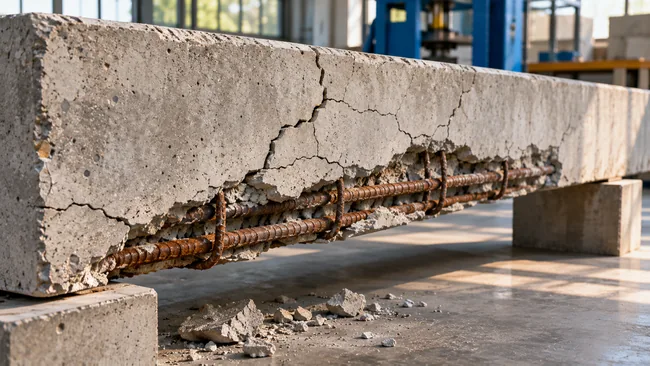
Designing reinforced concrete rationally means understanding how it behaves and fails. This class looks at that behavior at four levels: the material, the element, the structure and the whole system. Early analysis of cracking, plasticity, creep and shear leads to design work on slabs, joints, thin shells, segmental bridges and tall buildings, with earthquake resistant design and repair as special topics.
What You Will Achieve
- Apply failure theories to concrete under multiaxial loading
- Analyze creep, shrinkage, ductility and shear in members
- Use yield line theory to study slabs
- Evaluate options for repair and seismic retrofit
Program Overview
Material Behavior
The first lectures study concrete itself.
- Micro-cracking of concrete
- Failure theories
- Concrete plasticity
- Fracture concepts
Members and Joints
The next lectures move to structural elements.
- Creep and shrinkage deformation
- Shear transfer
- Biaxial bending
- Beam column joints
Structural Systems
The later lectures reach whole structures.
- Yield line theory for slabs
- Thin shell structures
- Segmental bridges and tall buildings
- Earthquake resistant design
Course Completion
Job Outlook
These skills apply to structural engineering, especially the design, evaluation, repair and strengthening of concrete buildings and bridges.
Good for: Civil engineering students who know basic structures and want a deeper account of why concrete design rules work.
Keep in mind: The term project and its reviews cannot be repeated with feedback, and you need the Nilson, Darwin and Dolan textbook. Code references date from the 2004 edition, so check current codes.
Bottom line: A bridge between concrete mechanics and design, with exams and homework for practice.
Frequently Asked Questions
Which textbook does the class use?
Design of Concrete Structures by Nilson, Darwin and Dolan, 13th edition, published by McGraw-Hill in 2004.
What could a term project address?
Published topics include seismic isolation, the Alamillo Bridge, nondestructive evaluation using acoustic methods, corrosion and durability, thin shell shape finding and retrofitting grain silos.
What do the homeworks cover?
A concrete gravity platform, creep strain in a building column, biaxial column interaction, shear and torsion, and yield line theory.




There are no reviews yet.