
Network Representations of Complex Engineering Systems

Course facts
- Payment: Free, no certificate
- Credits: Non Credit
- Learning style: Self-paced, start anytime
- Resources: Lecture Notes; Projects
MIT OpenCourseWare details
- As taught in: Spring 2010
- Department: Engineering Systems Division

| Course Details | ||||||
|---|---|---|---|---|---|---|
|
||||||
| Outcomes | ||||||
|
||||||
| Price & Terms | ||||||
|
||||||
| Technical | ||||||
|
||||||
| Specification | ||||||
|
||||||

Analyze complex engineering systems with network methods: metrics, architecture, flexibility and random networks, with a real-system case study.
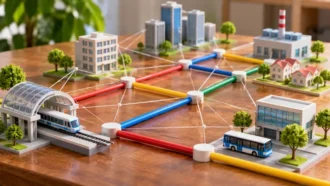
Large engineering systems can be studied as networks, and this research-level class teaches students to analyze them that way. It covers graphs, hierarchies and design structure matrices, along with network metrics, random networks, complexity and flexibility. Each student applies these methods to a real system in a case study, comparing structures across communication, infrastructure, organizations and biology.
What You Will Achieve
- Represent a system with graphs, hierarchies and DSMs
- Calculate basic network metrics using MATLAB
- Compare a system’s architecture to canonical structures
- Analyze a large system using observational data and models
Program Overview
Network Foundations
The first lectures build the basic tools.
- Introduction to graphs, networks, hierarchies, and DSMs
- MATLAB and network representations
- Basic network metrics and operations
Structure and Constraints
The next lectures consider system form.
- Canonical structures
- Complexity and flexibility
- Random networks
- Scaling and allometry as constraints
Technological and Organizational Systems
The last lectures reach applications.
- Affiliation networks
- Technological networks
- Modeling organizational architecture
- Reuse and standards
Course Completion
Job Outlook
These methods support research in systems engineering, along with the analysis of organizations and infrastructure.
Good for: Doctoral students and researchers in engineering systems who want to learn network analysis through a real case study.
Keep in mind: The project depends on finding data for a system of your own, and research readings beyond the text are not listed here. Faculty reviews of project work cannot be repeated.
Bottom line: A useful research orientation for network analysis of real systems, with a detailed project template.
Frequently Asked Questions
Which book is required?
Six Degrees: The Science of a Connected Age by Duncan Watts, along with additional research literature assigned before class.
What systems have past projects studied?
Local telephone and electrical networks, UN climate document exchange, music sales patterns, a supply chain, a Cambridge wireless system, and a product with its design team.
What goes in the final report?
System description, history and evolution, an assessment of effectiveness over time, possible architectural improvements, and reflections on methods, in less than 20 pages of text.
User Reviews
Write your review
You must be logged in to post a review.
Reviews can only be posted by registered learners. Log in or create a free account, then you will return here to post.



There are no reviews yet.