
Photovoltaic Solar Energy Systems
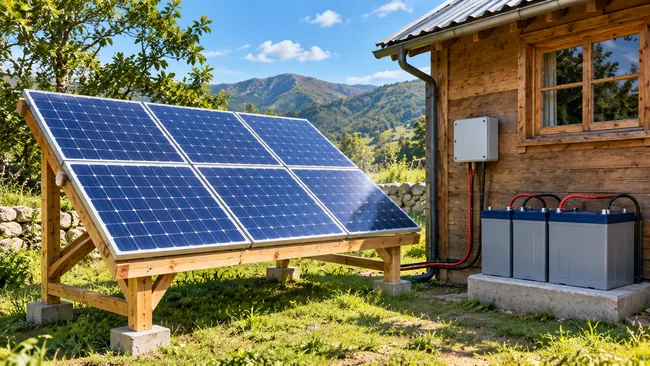
Course facts
- Payment: Free, no certificate
- Credits: Non Credit
- Learning style: Self-paced, start anytime
- Resources: Activity Assignments; Lecture Notes; Written Assignments
MIT OpenCourseWare details
- As taught in: Fall 2004
- Department: Edgerton Center

| Course Details | ||||||
|---|---|---|---|---|---|---|
|
||||||
| Outcomes | ||||||
|
||||||
| Price & Terms | ||||||
|
||||||
| Technical | ||||||
|
||||||
| Specification | ||||||
|
||||||

Design a stand-alone photovoltaic system: estimate the solar resource, predict module output, size batteries and arrays, and calculate costs.
A stand-alone solar installation has no grid behind it, so its panels and batteries must be sized to meet the load on their own. This short class works through that problem for US sites, using solar geometry, insolation data and module behavior, then probability of loss of load, and closes with grid-connected systems and the costs and benefits of an installation.
What You Will Achieve
- Estimate the insolation at a US site from database records
- Predict photovoltaic module output under changing temperature and insolation
- Do a first order design of a stand-alone system with battery storage
- Calculate net present value for a photovoltaic project with government subsidies
Program Overview
Solar Resource and Modules
How much sunlight reaches a surface and what a module makes of it.
- Solar geometry and the clearness index
- Monthly average daily insolation
- Current-voltage characteristics
- Array orientation and tracking
Stand-alone System Sizing
Matching storage and array to a load.
- Battery characteristics and charge control
- First order sizing
- Probability of loss of load
- Day-to-day correlation
Grid-connected Systems and Economics
Connecting to the utility and deciding whether the numbers work.
- Power conditioning
- Utility constraints
- PV cost and benefit calculations
Course Completion
Job Outlook
Sizing and cost estimates of this kind are used in solar energy planning and off-grid power projects, including conceptual design work for specific sites.
Good for: Anyone planning or studying an off-grid solar installation who wants to work the sizing and cost calculations themselves.
Keep in mind: Taught in fall 2004 for US locations, its technology, policy, market and subsidy details reflect that year, and the readings handed out in class are not part of the site.
Bottom line: Five exercises build step by step toward a conceptual design of your own stand-alone solar system.
Frequently Asked Questions
How do the assignments fit together?
Five exercises build toward a final report, and those exercises and the report instructions are published. Reflections on Exercises 2 and 4 are included as well.
What is loss of load probability doing here?
Sizing sessions use a Markov process model to estimate the probability of loss of load, then consider how day-to-day correlation in sunlight changes the estimate for a stand-alone system.
Can the design method be used outside the United States?
The syllabus sets the goal as a conceptual design for a location anywhere in the US, and the solar database sessions use US sites, so other regions would need their own data.

There are no reviews yet.