
Projects in Microscale Engineering for the Life Sciences
Course facts
- Payment: Free, no certificate
- Credits: Non Credit
- Learning style: Self-paced, start anytime
- Resources: Image Gallery; Lecture Notes; Presentation Assignments; Problem Sets; Written Assignments
MIT OpenCourseWare details
- As taught in: Spring 2007
- Department: Health Sciences and Technology, Electrical Engineering and Computer Science

| Course Details | ||||||
|---|---|---|---|---|---|---|
|
||||||
| Outcomes | ||||||
|
||||||
| Price & Terms | ||||||
|
||||||
| Technical | ||||||
|
||||||
| Specification | ||||||
|
||||||

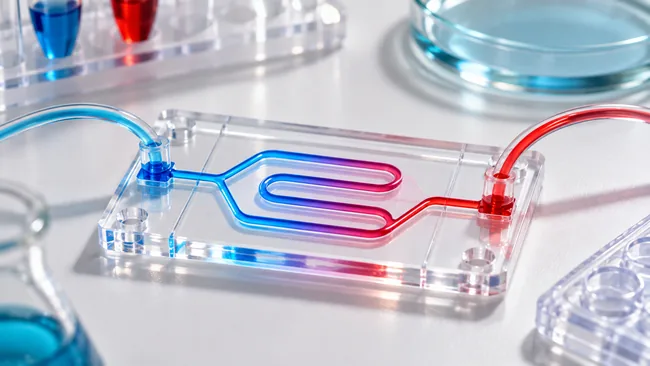
A project class on making microfluidic devices to manipulate and measure cells: channels, cell sorting, optical detection and a team-built prototype.
How do you build tools small enough to handle a single cell? Written for first-year students, this project class teaches making and using microfluidic channels, sorting cells and biomolecules, and measuring them optically. After introductory lab exercises and readings, small groups design, fabricate and test their own device in the second half of term.
What You Will Achieve
- Design and make microfluidic channels
- Explain laminar flow and diffusion at small scales
- Measure cells using optical detection and fluorescent labeling
- Propose a testable hypothesis and test a prototype
Program Overview
Microfluidics and Cells
The first sessions cover the tools and the things they handle.
- Microfluidics
- Microfabrication
- Cells and membranes
- Laminar flow
Analysis and Research
Next come data and real laboratories.
- Models of diffusion and cell experiment
- Data analysis using MATLAB
- Research paper discussion
- Cell traps
Projects
The second half of the term is given to one team project.
- Project brainstorming
- Device fabrication
- Dry runs
- Project presentations
Course Completion
Job Outlook
This experience points toward bioengineering, medical device research and laboratory work in the life sciences.
Good for: Students curious about bioengineering, and instructors planning a hands-on first-year microfluidics class.
Keep in mind: From spring 2007, and centered on lab work that needs microfabrication facilities. Its project description also varies between pages. There is no required text, and no solutions are listed for the problem sets.
Bottom line: An inviting first look at engineering with cells, most useful to people who can get into a lab.
Frequently Asked Questions
Do I need a lab to do the work?
For most of it, yes. Lab sessions and device fabrication need equipment, although the problem sets and data analysis scripts can be used anywhere.
Which software is used?
MATLAB. One session covers data analysis with it, and the materials include scripts for computing squared error against erf and erfc functions.
What should the team project show?
An improvement on an existing microfluidic design or technique, shown with a working prototype and presented in a 12-minute talk.



There are no reviews yet.