
Special Topics: New Textiles
Course facts
- Payment: Free, no certificate
- Credits: Non Credit
- Learning style: Self-paced, start anytime
- Resources: Design Assignments with Examples; Image Gallery; Other Video; Projects with Examples
- Before you start: While useful, prior experience with textiles, electronics, and programming is not required.
MIT OpenCourseWare details
- As taught in: Spring 2010
- Department: Media Arts and Sciences

| Course Details | ||||||
|---|---|---|---|---|---|---|
|
||||||
| Outcomes | ||||||
|
||||||
| Price & Terms | ||||||
|
||||||
| Technical | ||||||
|
||||||
| Specification | ||||||
|
||||||

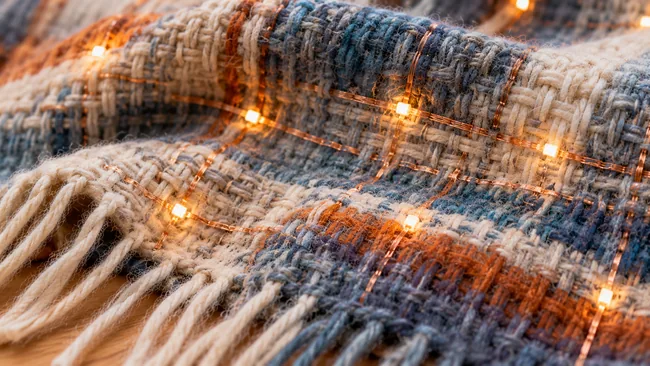
Project-based textiles: soft circuits, fabric PCBs, yarn, nonwovens, wearable computing, CNC knitting, embroidery and algorithmic patterns.
Crafting traditions and new technologies meet in this project-based studio on the future of textiles. Work spans textile-based electronics, fabrication, algorithmic pattern design and composites, using wool and cotton alongside metal fibers, fusible plastics, papers and resins. Techniques include felting, laser cutting, CNC knitting, digital printing and CNC embroidery, with weekly hands-on assignments and a final project.
What You Will Achieve
- Make a soft circuit and a fabric PCB
- Create textile sensors with conductive materials
- Spin a yarn and make a nonwoven fabric
- Build a networked wearable and present a final textile project
Program Overview
Conductive Textiles and Fabric PCBs
Electronics built into cloth.
- Conductive textiles
- Textile sensors
- Fabric PCBs
Fibers, Yarns and Nonwovens
The materials, and a workshop on spinning them.
- Fibers and yarns
- Spinning workshop
- Nonwovens
Wearable Computing and Fabric Structures
Networked garments and ways of making cloth.
- Wearable computing
- Embroidery and printing
- Knitting and weaving
- Pattern design
Course Completion
Job Outlook
These skills apply to work in smart textiles, wearable technology and experimental design and fabrication.
Good for: Makers, designers and engineers who want project ideas that combine textile craft with electronics and digital fabrication.
Keep in mind: Some activities are flagged as potentially hazardous and need safety training, special facilities and supervision. Many sessions were guest lectures and visits, and machines such as CNC knitters are not home tools.
Bottom line: A rich source of textile technology projects, with examples and galleries to spark your own experiments.
Frequently Asked Questions
What are the assignments?
They include a soft circuit, a two-part fabric PCB, a yarn, a nonwoven, a networked wearable, and a knit, woven, embroidery or print piece, leading to a final project.
What safety warning applies?
The course carries a notice that an activity is potentially hazardous and requires safety training, special facilities, equipment and supervision. Responsibility for those measures rests with you.
Which textbook is listed?
Textiles by S. J. Kadolph and A. L. Langford, 10th edition. Published materials also include design assignments with examples, an image gallery and video.
User Reviews
Write your review
You must be logged in to post a review.
Reviews can only be posted by registered learners. Log in or create a free account, then you will return here to post.

There are no reviews yet.