
Basic Electronics and Circuit Design
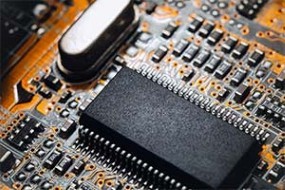

Learn about theorems in electric circuits design, diode rectifiers, BJT amplifier, waveform conversion, basic logical operation, and ADC and DAC principles.
This free online basic electronics course will teach you about theorems used in the design of electric circuits, the simulation of various RC and RL circuits, and an introduction to half-wave and full-wave diode rectifiers.The course will also teach you about the basic operation of a BJT amplifier, various waveform conversion, basic logical operation, Karnaugh maps, introduction to the binary number system, and also, ADC and DAC principles.
What You Will Learn In This Free Course
Electronics and Useful Circuit Techniques
In this module, you will be introduced to the ENIAC computer, semiconductor technology, and also superposition as well as the Thevenin’s theorem, and graphical method for finding Thevenin’s voltage and resistance. You will also be introduced to Norton’s equivalent circuits, sinusoidial steady state, as well as the use of phasors in circuit analysis.
RC/RL Circuits in Time Domain
In this module, you will be introduced to RC and RL circuits with DC sources, as well as charging and discharging transients in RC circuits. You will also be introduced to examples involving RC circuits and RL circuits, and also, a simulation of RC circuits and RL circuits.
Diode Circuits
In this module, you will be introduced to the I-V relationship of a diode, the Shockley model, as well as the input and output voltages of two diode circuits. You will also be introduced to reverse conduction of a diode, peak detector circuit, and also a voltage doubler circuit.
Diode Rectifiers and BJT
In this module, you will be introduced to half-wave and full-wave diode rectifiers, charging and discharging of a filter capacitor, and also, average and peak diode currents. You will also be introduced to the types of BJT, a simple BJT circuit, as well as Ebers moll’s model of a BJT.
BJT Amplifiers
In this module, you will be introduced to the basic operation of the BJT amplifier, how the gain is affected by various parameters, as well as an improved biasing scheme. You will also be introduced to the basic form of the BJT small signal model, the common emitter amplifier, and also, combining the DC and the AC solutions.
Introduction to Op-Amps
In this module, you will be introduced to the general representation of an amplifier, the advantages of operational amplifier or op-amp, and also the op-amp circuit analysis. You will also be introduced to input and output resistances of the non-inverting amplifier, the operation of the summer, as well as the common mode rejection ratio or CMRR.
Advanced Diploma in Basic Electronics – First Assessment
You need to score 80% or more to pass.; Module
Instrumentation Amplifier and Bode Plots
In this module, you will be introduced to the effect of resistance mismatch, current-voltage converter and integrator, as well as the slight variations of the real op-amp. You will also be introduced to op-amp filters, a transfer function in Bode plots, and also, the contribution of the pole and the zero to Bode plots.
Op-Amp Filters and Precision Rectifiers
In this module, you will be introduced to the construction of Bode plots, op-amp filters in a simple circuit, and also, the simulation of an op-amp filter and plot the magnitude of the transfer function. You will also be introduced to the combination of an op-amp and a diode for peak detection.
Schmitt Triggers and Sinusoidal Oscillators
In this module, you will be introduced to a design problem based on the conversion of a triangular input voltage to a sinusoidal output voltage, op-amp circuits based on positive feedback, and also, the application of the Schmitt trigger. You will also be introduced to the advantages of the Schmitt trigger, as well as the principle of operation of a sinusoidal oscillator.
Introduction to Digital Circuits
In this module, you will be introduced to the basic logical operations, simplifying logical functions, and also, the use of Karnaugh maps to minimize a given logical function. You will also be introduced to the binary number system, a multiplexer, as well as commonly used blocks called commercial ICs.
Introduction to Sequential Circuits
In this module, you will be introduced to the encoder and the different class of digital circuits, a latch made up of NOR gates, as well as the master-slave configuration of the JK flip flop. You will also be introduced to a simple circuit consisting of various JK flip flops, a bi-directional shift register, and also, a few specific counter circuits.
ADC and DAC Conversion
In this module, you will be introduced to the design of synchronous counters, simulation of a synchronous counter, as well as the 555 monostable multivibrator. You will also be introduced to DAC using binary weighted resistors, R-2R ladder network, and also, counting ADC or digital ramp ADC.
Advanced Diploma in Basic Electronics – Second Assessment
You need to score 80% or more to pass.; Module
Course assessment
User Reviews
Be the first to review “Basic Electronics and Circuit Design”
You must be logged in to post a review.





There are no reviews yet.