
Most Complete Teaching of STP by Arash Deljoo
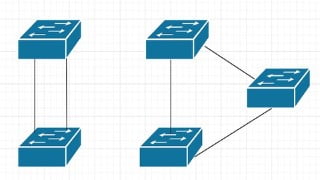

Learn about Spanning-Tree Protocol (STP) and its variations, including RSTP and MSTP, to build loop-free Ethernet networks. Prevent bridge loops and ensure fault tolerance with this comprehensive course for network engineers.
What you’ll learn
- Spanning-Tree Protocol (STP) Introduction
- Spanning-Tree Protocol (STP) Configuration
- Spanning-Tree Protocol (STP) Verification
- Rapid Spanning-Tree Protocol (RSTP) Introduction
- Rapid Spanning-Tree Protocol (RSTP) Configuration
- Rapid Spanning-Tree Protocol (RSTP) Verification
- Multiple Spanning-Tree Protocol (MSTP) Introduction
- Multiple Spanning-Tree Protocol (MSTP) Configuration
- Multiple Spanning-Tree Protocol (MSTP) Verification
- Spanning-Tree Protocol (STP) Protection Introduction
- Spanning-Tree Protocol (STP) Protection Configuration
- Spanning-Tree Protocol (STP) Protection Verification
Show moreShow less
The Spanning Tree Protocol (STP) is a network protocol that builds a loop-free logical topology for Ethernet networks. The basic function of STP is to prevent bridge loops and the broadcast radiation that results from them. Spanning tree also allows a network design to include backup links providing fault tolerance if an active link fails.
As the name suggests, STP creates a spanning tree that characterizes the relationship of nodes within a network of connected layer-2 bridges, and disables those links that are not part of the spanning tree, leaving a single active path between any two network nodes. STP is based on an algorithm that was invented by Radia Perlman while she was working for Digital Equipment Corporation.
In 2001, the IEEE introduced Rapid Spanning Tree Protocol (RSTP) as 802.1w. RSTP provides significantly faster recovery in response to network changes or failures, introducing new convergence behaviors and bridge port roles to do this. RSTP was designed to be backwards-compatible with standard STP.
STP was originally standardized as IEEE 802.1D but the functionality of spanning tree (802.1D), rapid spanning tree (802.1w), and multiple spanning tree (802.1s) has since been incorporated into IEEE 802.1Q-2014.
The need for the Spanning Tree Protocol (STP) arose because switches in local area networks (LANs) are often interconnected using redundant links to improve resilience should one connection fail. However, this connection configuration creates a switching loop resulting in broadcast radiations and MAC table instability If redundant links are used to connect switches, then switching loops need to be avoided.
To avoid the problems associated with redundant links in a switched LAN, STP is implemented on switches to monitor the network topology. Every link between switches, and in particular redundant links, are catalogued. The spanning-tree algorithm then blocks forwarding on redundant links by setting up one preferred link between switches in the LAN. This preferred link is used for all Ethernet frames unless it fails, in which case a non-preferred redundant link is enabled. When implemented in a network, STP designates one layer-2 switch as root bridge. All switches then select their best connection towards the root bridge for forwarding and block other redundant links. All switches constantly communicate with their neighbors in the LAN using bridge protocol data units (BPDUs).
Who this course is for:
- Network Engineers
User Reviews
Be the first to review “Most Complete Teaching of STP by Arash Deljoo”
You must be logged in to post a review.





There are no reviews yet.