
Sustainability Management in Business


Learn how to design practical strategies for addressing sustainability challenges in business operations. Develop skills to create sustainable value and competitive advantages. Gain knowledge on analyzing, planning, leading, and managing sustainable business operations in a rapidly changing environment. This course is ideal for young executives, practitioners, and graduate students interested in sustainability management.
What you’ll learn
- Develop skills to design a practical approach with strategies for addressing sustainability challenges in operations at your organization.
- Build confidence to identify sustainable new business opportunities, create sustainable value and competitive advantages for the company.
- Develop skills required to analyze, plan, lead, and manage sustainable business operations in a rapidly changing business environment.
- Advance your skills to adapt decision-making tools and practices to shape your organization in meeting the call of sustainability in achieving SDGs.
The focus on sustainability, as measured by ESG, is how companies can create value for all stakeholders, including the financial return for the shareholders through long-term value preservation. The flourishing businesses of the future proactively respond to today’s global challenges, create sustainable value, and deliver net-positive impacts to society and the natural environment. Business organizations should recognize the need to respond to global challenges by changing their business model, operations, and practices. Socio-ecological problems such as climate change, biodiversity loss, water scarcity, natural resource degradation and global inequality have been worsening and not improved for the last several decades.
Businesses worldwide operate in a rapidly changing global ecosystem (environmental, social and economic ecosystem) and are held to increasingly demanding environmental and social standards. With this volatile, complex, and global uncertainty, businesses must understand key environmental and societal risks and opportunities. Therefore, future executives and managers who lead these businesses must understand how these socio-ecological factors affect their business.
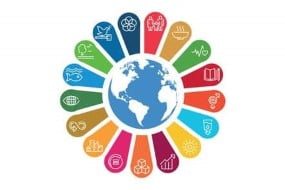
The ability to deliver products and services sustainability and meet the needs of today without sacrificing the needs of future generations presents one of the most extensive business opportunities to create value for businesses. The Agenda 2030 by United Nations provided a strong driver: Sustainable Development Goals (SDGs) to transform business organizations to seize the opportunity.
Although sustainability is the responsibility of all members of an organization, young executives and professionals in the global workforce must have to play a significant role. Their capabilities to describe, analyze, manage, and communicate how value is created and captured while maintaining or regenerating natural, social, and economic capital beyond its organizational boundaries is important to build the resilience of the business ecosystem than ever before. Sustainability management needs to be integrated into business operations throughout the value chain and across every single business function. New skills and knowledge are critical to creating the impact of sustainability management in business on organizational-level outcomes such as social, environmental, and economic performance and the system-level outcome of socio-ecological resilience for successful companies.
This course is designed to assist young executives, practitioners, and graduate students/interns keen on developing the knowledge, skills, and perspectives on sustainability management in business. Through a combination of lectures, workbook exercises, practice quizzes, course final assessment, you will be able to develop skills required to analyze, plan, lead, and manage sustainable business operations in a rapidly changing business environment. In this online course, you will also gain exposure to the state-of-art concept of sustainability and value chain, fundamentals of sustainability management, shared value creation, systems thinking and circular business model, sustainable designs strategies, sustainable consumption, and production, measuring the sustainability performance, opportunities and challenges, managing environment, social and governance (ESG) issues. You’ll be guided with tools to adopt a practical approach with strategies through workbook exercises for your business organization and develop an action plan. At the end of this course, you’ll be confident with the knowledge and required skills on integrating sustainability across the value chain for delivering net-positive impacts to society, the natural environment, and the business.
Who this course is for:
- This course is designed to assist young executives, practitioners and graduate students/interns in developing skills and the knowledge they need to understand and address sustainability challenges and contribute to transforming their business organisations that meet the social and environmental needs while delivering better returns to shareholders and stakeholders.
- Young executives and professionals engaged in sustainability activities.
- Sustainability practitioners and consultants
- Graduate students and interns engaged in sustainability activities
- Engineering, science, business, and sustainability students who are keen on sustainability careers in future
User Reviews
Be the first to review “Sustainability Management in Business”
You must be logged in to post a review.




There are no reviews yet.