
Prototyping Avionics
Course facts
- Payment: Free, no certificate
- Credits: Non Credit
- Learning style: Self-paced, start anytime
- Resources: Lecture Notes; Problem Sets
MIT OpenCourseWare details
- As taught in: Spring 2006
- Department: Aeronautics and Astronautics

| Course Details | ||||||
|---|---|---|---|---|---|---|
|
||||||
| Outcomes | ||||||
|
||||||
| Price & Terms | ||||||
|
||||||
| Technical | ||||||
|
||||||
| Specification | ||||||
|
||||||

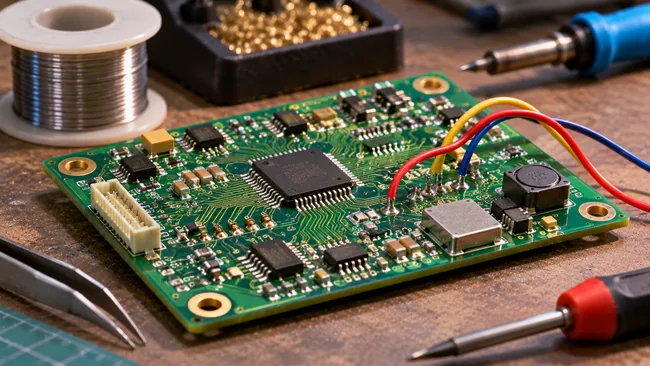
Learn to design, build and debug printed circuit boards for avionics, with schematic capture, layout, assembly, testing and documentation.
Cheap board manufacture changed how electronics get prototyped: you can now order a board you expect to contain errors, debug it, and revise it. The practical skill this calls for is carrying a circuit through schematic capture, layout, assembly and testing. A month of electrical engineering review comes first, and a final two-layer board project of up to 30 parts ties it together.
What You Will Achieve
- Identify the main components of an avionics prototype
- Use schematic capture software to create detailed schematics
- Use PCB layout programs to route a two-layer board
- Plan the test and debug process for an assembled board
Program Overview
Electronics Review
Discrete, power and digital parts, reviewed with protoboard work in mind.
- Transistors and power components
- Digital components
- Processors
- Interfacing digital and analog
Schematics and Layout
Turning a design into a captured schematic and then a routed board.
- Schematic parts and advanced tools
- PCB design basics
- Routing and finishing
Assembly, Debugging and Documentation
Getting the board to work and recording how it behaves.
- Assembly tips
- Testing and debugging
- Circuit documentation
- Complex embedded systems
Course Completion
Job Outlook
Board-level design and debugging skills are used in avionics, robotics and embedded product development, wherever a protoboard circuit becomes a manufactured prototype.
Good for: Aerospace and robotics builders who want to carry their own circuit through to a manufactured board.
Keep in mind: From spring 2006: lecture notes and three of four problem sets, no videos. Labs ran in person, so you need your own parts and CAD tools; it does not replace a full electronics class.
Bottom line: Despite the avionics title, this is a compact walk through making a printed circuit board, with a clear final project brief.
Frequently Asked Questions
How complex is the final project board?
The brief sets limits of 30 parts, no component over 30 pins, no ball grid arrays, at most three operating voltages, and two layers, with digital control, an analog circuit and power regulation.
What do I deliver for the project?
The brief lists a full schematic, bill of materials, layout and manufacturing files, a data sheet style description of the circuit, and an account of designing, building and testing it.
Which book should I use?
The class requires no textbook, because the class stresses locating and understanding product data sheets. The Art of Electronics by Horowitz and Hill is suggested as optional help during the electronics review.

There are no reviews yet.