
Sustainable Building with Timber
Course facts
- Payment: Free to learn, certificate paid
- Credits: Non Credit
- Learning style: Self-paced, start anytime
- Format: Video Based
edX details
- Pacing: Self-paced
- Available until: Jul 7, 2027

| Course Details | ||||||||
|---|---|---|---|---|---|---|---|---|
|
||||||||
| Languages | ||||||||
|
||||||||
| Outcomes | ||||||||
|
||||||||
| Price & Terms | ||||||||
|
||||||||
| Technical | ||||||||
|
||||||||
| Specification | ||||||||
|
||||||||

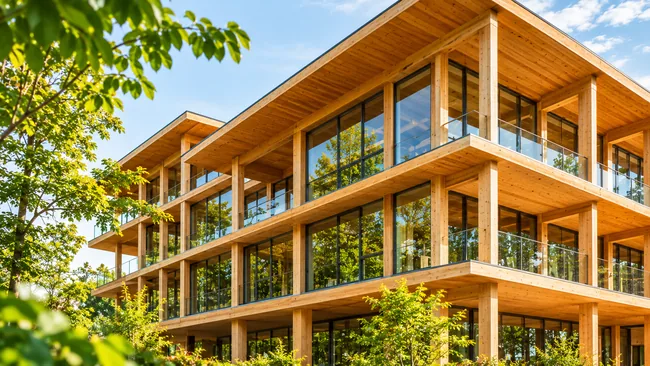
Learn how sustainable forestry, life cycle assessment, timber structures and prefabrication can lower the carbon footprint of buildings.

Timber construction is put forward here as a response to the emissions, resource scarcity, health and housing pressures tied to building with concrete, metals and plastics. You follow a supply chain that links sustainable forest management with timber construction, see how wood can store carbon in forests and in buildings, and look at circular practices that let timber structures be reused within a single building and across a region.
What You Will Achieve
- Read life cycle assessment results to compare a timber building’s climate impact with one built of concrete or metal
- Identify circular timber design typologies that let timber structures be reused
- Check how a timber load-bearing structure holds together and stays stable
- Explain why moving construction work off the site and into a manufacturing hall makes building cleaner and quicker
Program Overview
Sustainability and Environmental Impacts of Timber
Sets out why the building sector should shift toward timber and bio-based materials, then weighs environmental impacts with Life Cycle Assessment and an illustrative case study.
- Circularity and the move toward a post-carbon building sector
- Forestry, policy and the timber value chain
- Life Cycle Assessment framework and case study
- Carbon footprints, end-of-life scenarios and product lifespans
Timber Construction Principles and Building Typologies
Traces how timber products evolved, how wood behaves as a structural material, and how timber is used in buildings of different heights and in hybrid systems.
- History of timber products, including sawn timber and CNC milling
- Wood properties, structural capacity, fire safety, seismic resistance and acoustics
- Building heights, refurbishments, topping-ups and tall timber
- Hybrid timber systems and composite concrete floors
Façades, Joinery and Prefabrication
Looks at joinery, timber façades and the thermal envelope, then at prefabrication in mass timber and the innovations expected in future timber construction.
- Joinery culture and its role in timber construction
- Façade products, water management and the thermal envelope
- Prefabrication of components and assembly with elements
- A virtual tour of a mass timber manufacturing hall
Certificate Awarded (Paid)
Complete the course to earn it. The course is free to study; the certificate is optional and has a fee.
Job Outlook
These skills apply in architecture, engineering, property development, consulting and policy work on the built environment, wherever timber and bio-based materials, circular building and lower-carbon construction are planned or assessed.
Good for: Architects, engineers, developers, consultants, policymakers and students who want a reasoned case for timber and the supply chain behind it.
Keep in mind: The course argues for timber over concrete, metals and plastics, and its sourcing case rests on sustainably managed temperate forests.
Bottom line: It ties forestry, life cycle assessment, structural principles and factory prefabrication into one argument for building with wood.
Frequently Asked Questions
Which partners helped develop the course?
It comes from TU Delft's Faculty of Architecture and the Built Environment and its Circular Built Environment Hub, working with VIA University College Denmark, FSC Netherlands, the AMS Institute and other partners within the HOME for the future project, which has EU support.
How is life cycle assessment used in the course?
Life Cycle Assessment is the method used to weigh the environmental impacts of timber against conventional materials. You learn its general framework, compare results in an illustrative case study, and then look at carbon footprints, end-of-life scenarios and why longer product lifespans matter.
Which kinds of timber buildings are discussed?
The lessons define building heights and look at low-rise and mid-rise buildings, refurbishments and topping-ups, and high-rise and tall timber construction. They also examine hybrid systems that combine wood species and composite concrete floors used in multi-story timber buildings.
How does the course show prefabrication in practice?
A short virtual tour of a conditioned manufacturing hall shows how construction activities can move away from building sites. The course links this to a building process that is cleaner, quicker, of higher quality and less of a nuisance on-site.
Please log in to report a problem with this page.



There are no reviews yet.