
Civil Engineering Materials Laboratory
Course facts
- Payment: Free, no certificate
- Credits: Non Credit
- Learning style: Self-paced, start anytime
- Resources: Demonstration Videos
MIT OpenCourseWare details
- As taught in: Spring 2004
- Department: Civil and Environmental Engineering

| Course Details | ||||||
|---|---|---|---|---|---|---|
|
||||||
| Outcomes | ||||||
|
||||||
| Price & Terms | ||||||
|
||||||
| Technical | ||||||
|
||||||
| Specification | ||||||
|
||||||

A laboratory class on measuring properties of engineering materials: tension, shear, concrete, compression and soil tests, with demonstration videos.
Measuring how materials deform and fail is the subject of this laboratory class, which introduces the concepts, techniques and devices engineers use on natural and fabricated materials. Ten weekly experiments cover tension, direct shear, concrete, compression, soil classification, consolidation and heat treatment. Each one asks students to collect data, analyze it, and present the interpreted results in a report.
What You Will Achieve
- Plan an experimental program and select test specimens
- Convert laboratory measurements into strength and stiffness values
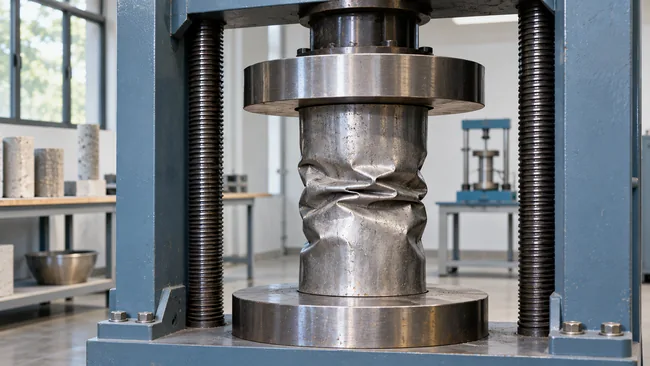
- Observe modes of failure in compression, tension and shear
- Document procedures, data and interpretation in a report
Program Overview
Instruments and Tension
The first experiments cover measurement equipment and metals under load.
- Data acquisition and instruments
- Tension: elastic behavior
- Tension: failure of common materials
Shear, Concrete and Compression
The middle experiments test other materials and loading.
- Direct shear and frictional behavior
- Concrete early age properties
- Compression and directionality
Soil and Heat Treatment
The last experiments address soils and how processing changes metals.
- Soil classification
- Consolidation test
- Tension: heat treatment
Course Completion
Job Outlook
These testing skills are used in civil and geotechnical engineering, particularly on structural and construction materials.
Good for: Civil engineering students who want to see how material tests are designed, with demonstration videos and lab procedures to follow.
Keep in mind: The experiments need a testing laboratory with loading frames and safety training, which the site cannot supply. Demonstration videos are the listed material, so this works as a guide to the tests.
Bottom line: A picture of what a materials testing lab teaches, useful as preparation for lab work of your own.
Frequently Asked Questions
Which experiments are in the class?
Ten: data acquisition, three tension labs, direct shear, two concrete labs, compression and directionality, soil classification, and a consolidation test.
What standards does the class mention?
The reference materials include the Annual Book of ASTM Standards from the American Society for Testing and Materials, along with readings set for each lab assignment.
What safety rules does the page give?
Rules include wearing eye protection with power tools or compression testing, checking transducer input voltage, and asking when in doubt, since a wrong guess may be dangerous or expensive.



There are no reviews yet.