
Design and Fabrication of Microelectromechanical Devices
Course facts
- Payment: Free, no certificate
- Credits: Non Credit
- Learning style: Self-paced, start anytime
- Resources: Lecture Notes; Problem Set Solutions; Problem Sets; Programming Assignments; Projects
MIT OpenCourseWare details
- As taught in: Spring 2007
- Department: Electrical Engineering and Computer Science, Mechanical Engineering

| Course Details | ||||||
|---|---|---|---|---|---|---|
|
||||||
| Outcomes | ||||||
|
||||||
| Price & Terms | ||||||
|
||||||
| Technical | ||||||
|
||||||
| Specification | ||||||
|
||||||

An introduction to MEMS design: microfabrication, lumped modeling, fluids, noise and feedback, with case studies and sample team projects.
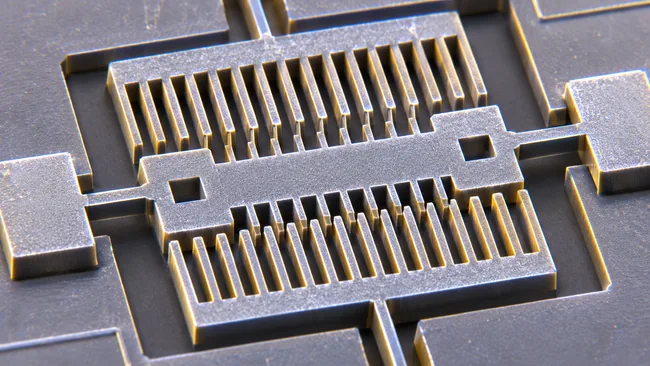
Pressure sensors, accelerometers and rate gyroscopes need knowledge of microfabrication, mechanics and electromagnetism all at once. This introduction to microsystem design teaches that mix, then asks student teams to design a sensor or actuator system that meets specifications using a realistic process. Modeling and simulation run through the term, and case studies draw on real applications.
What You Will Achieve
- Create process flows and relate them to device geometry
- Build lumped-element models of systems and transducers
- Model dissipation, fluid damping and transport at the microscale
- Design a microsystem to meet sensitivity and signal-to-noise specifications
Program Overview
Microfabrication and Materials
The opening lectures cover how devices are made and the properties that limit them.
- Bulk and surface micromachining
- Process flows
- Fabrication for the life sciences
- Material properties
Modeling and Physics
Most of the term builds models across the mechanical, electrical, thermal and fluid domains.
- Lumped-element modeling
- Energy-conserving transducers
- Thermal energy domain and dissipation
- Fluids, transport, feedback and noise
Packaging and Case Studies
The last lectures run while teams finish their projects.
- Packaging and design tradeoffs
- Power and optical MEMS
- Capacitive accelerometer
- BioMEMS
Course Completion
Job Outlook
These skills apply to the design of MEMS such as sensors, actuators, optical devices and bioMEMS.
Good for: Electrical and mechanical engineering students moving into MEMS who want design practice, with parallel lectures covering whichever of mechanics or electronics they lack.
Keep in mind: Prior fabrication experience is desirable, and the design projects were done in teams of four or five. The published projects stress modeling and simulation, and no fabrication facility comes with the materials.
Bottom line: A design course with solved problem sets, a project brief and sample projects that make a good template for your own microsystem.
Frequently Asked Questions
What is the team design project?
Teams design a microsystem of sensors or actuators, electronics and feedback to meet specifications such as sensitivity, frequency response and linearity, using a realistic microfabrication process. Report guidelines and sample projects are published.
What if I know mechanics but not electronics?
Two lectures ran in parallel on introductory mechanics and introductory electronics, so each student took the side they lacked. The published schedule lists both, as elasticity or electronics I and structures or electronics II.
Which MEMS applications are the case studies?
The case studies cover power MEMS, optical MEMS, a capacitive accelerometer and bioMEMS, alongside lectures on packaging and design tradeoffs.



There are no reviews yet.