
Design and Manufacturing II

Course facts
- Payment: Free, no certificate
- Credits: Non Credit
- Learning style: Self-paced, start anytime
- Resources: Exam Solutions; Exams; Lecture Notes; Problem Sets; Projects
- Before you start: 2.007 Design and Manufacturing I
MIT OpenCourseWare details
- As taught in: Spring 2025
- Department: Mechanical Engineering

| Course Details | ||||||
|---|---|---|---|---|---|---|
|
||||||
| Outcomes | ||||||
|
||||||
| Price & Terms | ||||||
|
||||||
| Technical | ||||||
|
||||||
| Specification | ||||||
|
||||||

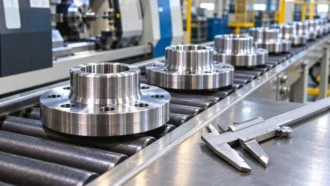
Manufacturing processes, equipment and systems: molding, machining, joining, casting, additive manufacturing, quality and system design.
How do you make intelligent decisions about a product you have never seen, made by a process you do not know? This course on modern manufacturing builds that judgment through four areas of emphasis: processes, equipment and control, systems, and design for manufacturing. It covers injection molding, thermoforming, metal cutting, joining and assembly, forming and casting, thin-film and additive manufacturing, then variation, quality and statistical process control, and how manufacturing systems are planned, costed and simulated.
What You Will Achieve
- Explain the physics and equipment of major processes such as molding, machining and casting
- Analyze cutting forces and power in machining
- Apply statistical process control to manage variation and quality
- Model the planning, cost and flow of a manufacturing system
Program Overview
Forming and Machining Processes
How polymer and metal parts are shaped and cut.
- Injection molding and thermoforming
- Metal cutting: mechanics, forces and power
- Machining in practice
- Forging, extrusion, sheet metal and casting
Assembly, Joining and Layered Manufacturing
Putting parts together, and building them up layer by layer.
- Assembly and disassembly
- Joining processes and assemblies
- Thin-film processes for MEMS and microelectronics
- Additive manufacturing
Quality and Manufacturing Systems
Controlling variation and designing the system that makes the product.
- Defining and measuring quality
- Statistical process control
- Manufacturing planning and cost
- System design and simulation, including transfer lines in MATLAB
Course Completion
Job Outlook
Manufacturing knowledge is used in manufacturing and process engineering, product design, quality engineering, operations and supply chain roles.
Good for: Engineering students who want to understand how products are actually made and what that means for design.
Keep in mind: The labs (CAD/CAM, CNC machining, mold design, measurement) and the team project were hands-on work in person; the materials are lecture notes, seven homeworks and two quizzes with solutions.
Bottom line: A thorough, practical tour of manufacturing processes and systems, with plenty of worked quiz practice.
Frequently Asked Questions
Is there exam practice?
Yes. Both quizzes come with review sheets and solutions, and there are practice quizzes from 2021 to 2024, most with solutions.
Which textbook goes with it?
The textbook is S. Kalpakjian's Manufacturing Engineering and Technology, in its 8th edition, published by Prentice Hall in 2001.
Does it use games or simulations?
Yes. Manufacturing systems are introduced through the Beer Game and a Lean Game, and transfer lines are modeled in MATLAB.

There are no reviews yet.