
Nanomechanics of Materials and Biomaterials
Course facts
- Payment: Free, no certificate
- Credits: Non Credit
- Learning style: Self-paced, start anytime
- Resources: Demonstration Videos; Exam Solutions; Exams; Lecture Notes; Simulation Videos; Written Assignments with Examples
- Before you start: 18.03 Differential Equations, 3.11 Mechanics of Materials (suggested) or permission of instructor.
MIT OpenCourseWare details
- As taught in: Spring 2007
- Department: Materials Science and Engineering

| Course Details | ||||||
|---|---|---|---|---|---|---|
|
||||||
| Outcomes | ||||||
|
||||||
| Price & Terms | ||||||
|
||||||
| Technical | ||||||
|
||||||
| Specification | ||||||
|
||||||

Forces at the nanoscale: force spectroscopy, AFM, adhesion, polymer elasticity and nanoindentation, with data-based homework and exams.
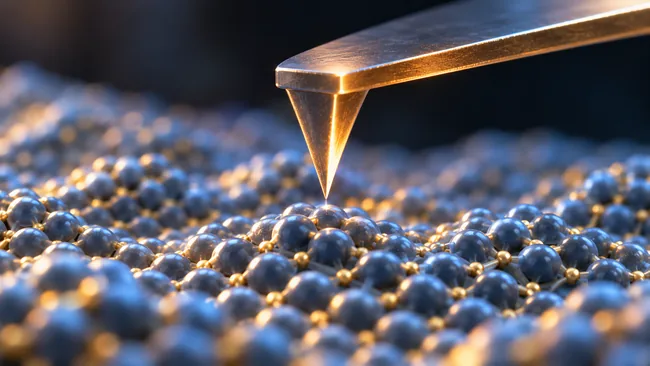
At the nanometer scale, mechanical properties are closely tied to chemistry and physics. This class studies forces at that scale through high resolution force spectroscopy and atomic force microscopy. It covers intermolecular forces, colloids and gecko adhesion, then polymer elasticity, titin and DNA, nanoindentation and cartilage. Theory is compared to recent data from the literature, with demonstrations and simulations.
What You Will Achieve
- Interpret force versus distance curves
- Identify artifacts in AFM imaging
- Model molecular forces and the electrical double layer
- Apply the worm-like chain and Oliver-Pharr methods
Program Overview
Instruments and Imaging
The first lectures introduce the tools.
- High resolution force spectroscopy
- Force versus distance curves
- Atomic force microscope (AFM) imaging
Forces and Surfaces
The next lectures study interactions.
- Intra- and intermolecular forces
- Colloids and interparticle potentials
- Gecko feet adhesion
- The electrical double layer
Polymers and Biomaterials
The later lectures reach applications.
- Nanomechanics of cartilage
- Elasticity of single polymer chains
- The giant protein titin and DNA
- Nanoindentation
Course Completion
Job Outlook
These skills support research in materials science, biomaterials and nanotechnology, including work with force microscopy.
Good for: Materials science and biomedical engineering students with differential equations, and ideally mechanics of materials.
Keep in mind: You cannot use an AFM here, though the homework supplies real data. Some multimedia needs old plugins, and the class reader and podcasts are not listed among the materials.
Bottom line: An introduction to nanomechanics, with worked solutions and exams.
Frequently Asked Questions
What data does the homework use?
Data files and images, including an AFM image of nacre and images for use with the free WSxM software. Some homeworks include solution data.
Is there a textbook?
No. Reading assignments are in a class reader, supplementary papers are suggested, and podcasts feature scientists in discussion with students.
Which exams are available?
The midterm and final exams with solutions, along with a midterm review and sample problems from prior years.
User Reviews
Write your review
You must be logged in to post a review.
Reviews can only be posted by registered learners. Log in or create a free account, then you will return here to post.



There are no reviews yet.