
Principles of Naval Architecture

Course facts
- Payment: Free, no certificate
- Credits: Non Credit
- Learning style: Self-paced, start anytime
- Resources: Instructor Insights; Projects
- Before you start: Students need to have taken one of these courses: 2.002 Mechanics and Materials II; 2.02B Mechanics of Structures
MIT OpenCourseWare details
- As taught in: Fall 2014
- Department: Mechanical Engineering

| Course Details | ||||||
|---|---|---|---|---|---|---|
|
||||||
| Outcomes | ||||||
|
||||||
| Price & Terms | ||||||
|
||||||
| Technical | ||||||
|
||||||
| Specification | ||||||
|
||||||

An introduction to naval architecture: ship geometry, hydrostatics, stability, resistance and hull strength, taught through seven design projects.
This introduction to naval architecture covers hydrostatics, curves of form, intact and damage stability, ship resistance and hull structure strength, and it introduces computer-aided design and analysis tools. Students analyze ship lines drawings, test a ship model and calculate hull strength in seven projects that apply each topic.
What You Will Achieve
- Analyze ship lines drawings and calculate hydrostatic characteristics
- Assess a ship’s intact and damage stability
- Estimate ship resistance through model testing
- Calculate hull structure strength
Program Overview
Geometry and Hydrostatics
The first part describes the hull and how it floats.
- Hydrostatics review
- Ship geometry
- Computer-aided design tools
- Rhino ship hull tutorial
Stability
The next lectures study how a ship stays upright, intact or damaged.
- Intact stability
- Ship general stability
- Hull subdivision
- Damage stability
Resistance and Strength
The final part deals with moving through water and carrying loads.
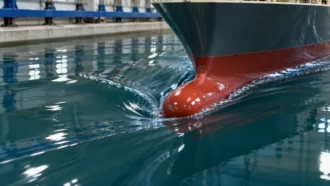
- Resistance and towtank lab
- Strength of ships
- Advanced hull forms
Course Completion
Job Outlook
Graduates go on to become naval architecture engineers and managers in commercial and government ship acquisition programs, construction and maintenance facilities and research centers.
Good for: Mechanical and ocean engineering students, and ship operators, who want a practical project-based introduction to ship design calculations.
Keep in mind: Only projects and instructor insights are published, with no lecture notes. The towtank labs cannot be repeated, and the projects call for CAD tools, plus statics and differential equations.
Bottom line: A project-driven introduction that teaches naval architecture by doing its core calculations.
Frequently Asked Questions
What do the seven projects cover?
Hull geometry, hydrostatics, ship intact stability, ship general stability, hull subdivision and damage stability, ship resistance model testing, and hull structure. A survey paper on naval architecture literature is assigned too.
Which CAD tool appears in the materials?
A Rhino ship hull tutorial is published with Project 2, and recitations were used for work with computer aided drafting tools.
Which reference books are listed?
Lewis's Principles of Naval Architecture volumes, Gillmer and Johnson's Introduction to Naval Architecture, and the newer Principles of Naval Architecture Series, which the syllabus calls useful but not required.



There are no reviews yet.