
Physiology of the Ear
Course facts
- Payment: Free, no certificate
- Credits: Non Credit
- Learning style: Self-paced, start anytime
MIT OpenCourseWare details
- As taught in: Fall 2004
- Department: Health Sciences and Technology

| Course Details | ||||||
|---|---|---|---|---|---|---|
|
||||||
| Outcomes | ||||||
|
||||||
| Price & Terms | ||||||
|
||||||
| Specification | ||||||
|
||||||

A paper-reading seminar on the auditory periphery: the middle ear, cochlear mechanics, hair cell motility and otoacoustic emissions.
How do the parts of the ear work together to turn sound into signals the brain can use? This seminar on the auditory periphery aims to show how the pieces fit together rather than to dig ever deeper into each one. It proceeds by reading and debating key research papers on the acoustics, mechanics and hydrodynamics of hearing, covering sound conduction, hair cell amplification and the sounds the ear itself emits. In the final third, students choose the topics, build the reading lists and lead the discussions.
What You Will Achieve
- Think critically about the major questions in auditory periphery research
- Explain how the middle ear and cochlea work together
- Assess evidence on hair cell motility, amplification and otoacoustic emissions
- Critique a research paper and frame questions about it
Program Overview
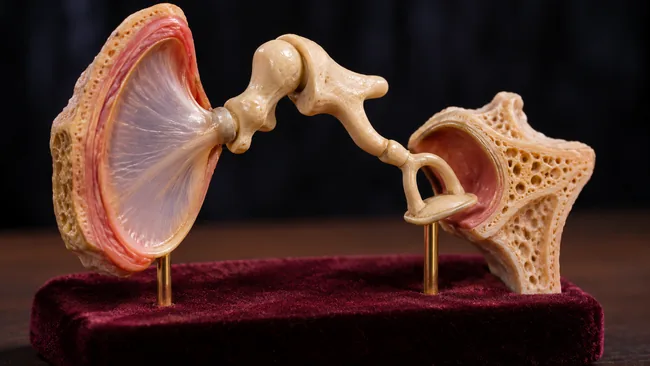
Middle Ear
How sound reaches the inner ear.
- Lecture on the middle ear
- Middle ear papers
Cochlear Mechanics
Mechanics of the cochlea and its hair cells.
- Cochlear mechanics papers
- Motility from hair cell stereocilia
- Outer hair cell somatic motility
- Otoacoustic emissions
Student-Selected Topics
Topics proposed, voted on and led by students.
- Changes in cochlear tonotopy during development
- Auditory nerve responses to speech
- Hearing organs across animals
- Hair cell transduction and adaptation
Course Completion
Job Outlook
The seminar prepares students for research in hearing science, auditory physiology, biomedical engineering and audiology.
Good for: Students in hearing science or biomedical engineering who are ready to read primary research on the ear.
Keep in mind: A fall 2004 seminar whose posted materials are its reading lists and guidelines for paper critiques and student-led topics; the discussions took place in class, so the value here lies in the curated papers.
Bottom line: A well-curated research reading list on the auditory periphery, built around critical discussion.
Frequently Asked Questions
How are papers discussed?
Students split into Questioners, who read enough to frame questions, and Answerers, who read in depth to answer them; everyone writes a one-page critique of each paper.
What did students choose to study?
Topics included acoustic distortion, cochlear development, auditory nerve responses to speech, computational hair cell models, hearing organs across animals and transduction channels.
Who taught it?
Professors John Guinan, Jr., John Rosowski and Christopher Shera led the lectures and paper discussions in the first two thirds of the course.

There are no reviews yet.