
Separation Processes for Biochemical Products
Course facts
- Payment: Free, no certificate
- Credits: Non Credit
- Learning style: Self-paced, start anytime
- Resources: Exams; Lecture Notes; Problem Sets
MIT OpenCourseWare details
- As taught in: Summer 2005
- Department: Chemical Engineering

| Course Details | ||||||
|---|---|---|---|---|---|---|
|
||||||
| Outcomes | ||||||
|
||||||
| Price & Terms | ||||||
|
||||||
| Technical | ||||||
|
||||||
| Specification | ||||||
|
||||||

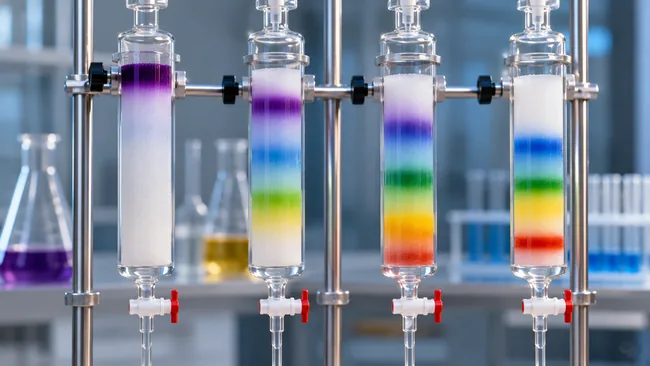
Recovering products from biological processes: cell disruption, centrifugation, filtration, chromatography, protein refolding and process design.
Once a biological process has made a protein or other product, it still has to be recovered and purified, and that downstream work shapes the whole process. This course introduces the fundamental separation operations for biochemical products: cell disruption, centrifugation, filtration and membranes, chromatography, extraction and protein refolding. It then turns to biochemical process design, synthesis and simulation, with case studies and process validation, focusing on the recovery methods scientists and engineers meet most in the lab and in industry.
What You Will Achieve
- Choose separation operations to recover a product from a biological process
- Analyze centrifugation, filtration and membrane steps for solid-liquid separation
- Explain how chromatography and extraction purify proteins
- Simulate a biochemical process and estimate its costs
Program Overview
Process Overview and Cell Disruption
Strategies for designing a recovery process.
- Strategies for biochemical process synthesis
- Biochemical processing overview
- Cell disruption
Separation and Purification
The core unit operations of product recovery.
- Centrifugation and filtration
- Membrane and rotary vacuum filtration
- Chromatography
- Protein refolding
Process Design and Validation
Putting the steps together into a process.
- Process synthesis, analysis and simulation
- A case study in innovation
- Process validation
Course Completion
Job Outlook
Downstream processing is central to work in biopharmaceutical manufacturing, bioprocess engineering and process development.
Good for: Chemical and biochemical engineers who want the fundamentals of recovering and purifying bioproducts.
Keep in mind: Listed as summer 2005 from MIT’s program in Malaysia, but last taught at MIT in 1999; its readings were published between 1985 and 2001, so check current bioprocess practice too.
Bottom line: A compact grounding in downstream bioprocessing, with cell disruption, purification and process validation in one sequence.
Frequently Asked Questions
Where was this version taught?
It was last taught at MIT in spring 1999 and then became part of the MIT Technology and Development Program at the Malaysia University of Science and Technology, and of MIT's Professional Institute.
Which case studies are in the readings?
Process economics for tissue plasminogen activator, process simulation for recombinant heparinase I, and the production of recombinant and biosynthetic human insulin.
What practice material is posted?
Lecture notes, five problem sets and two exams; the readings are chapters from biotechnology treatises and journal articles listed in the syllabus.

There are no reviews yet.